This week in KDE: nicer digital signing in Okular

There’s some of interesting Plasma 6 news, but I’m saving it for another post in a day or two, so it doesn’t distract from all the great work that KDE contributors landed on other things this week! So let’s dig into that:

New Features

Okular’s digital signature workflow has been improved, and now offers you the opportunity to add various pieces of metadata such as “reason” and “location” to the signature, and also to optionally add a background image behind it (Sune Vuorela, Okular 23.08. Link):

User Interface Improvements

You can now double-click on a tab in Dolphin to create a duplicate of it (Méven Car, Dolphin 23.08. Link)

When Elisa switches album art between one image and another one, it’s now smoother and nicer-looking, with no visual flash or flicker (Fushan Wen, Elisa 23.08. Link)

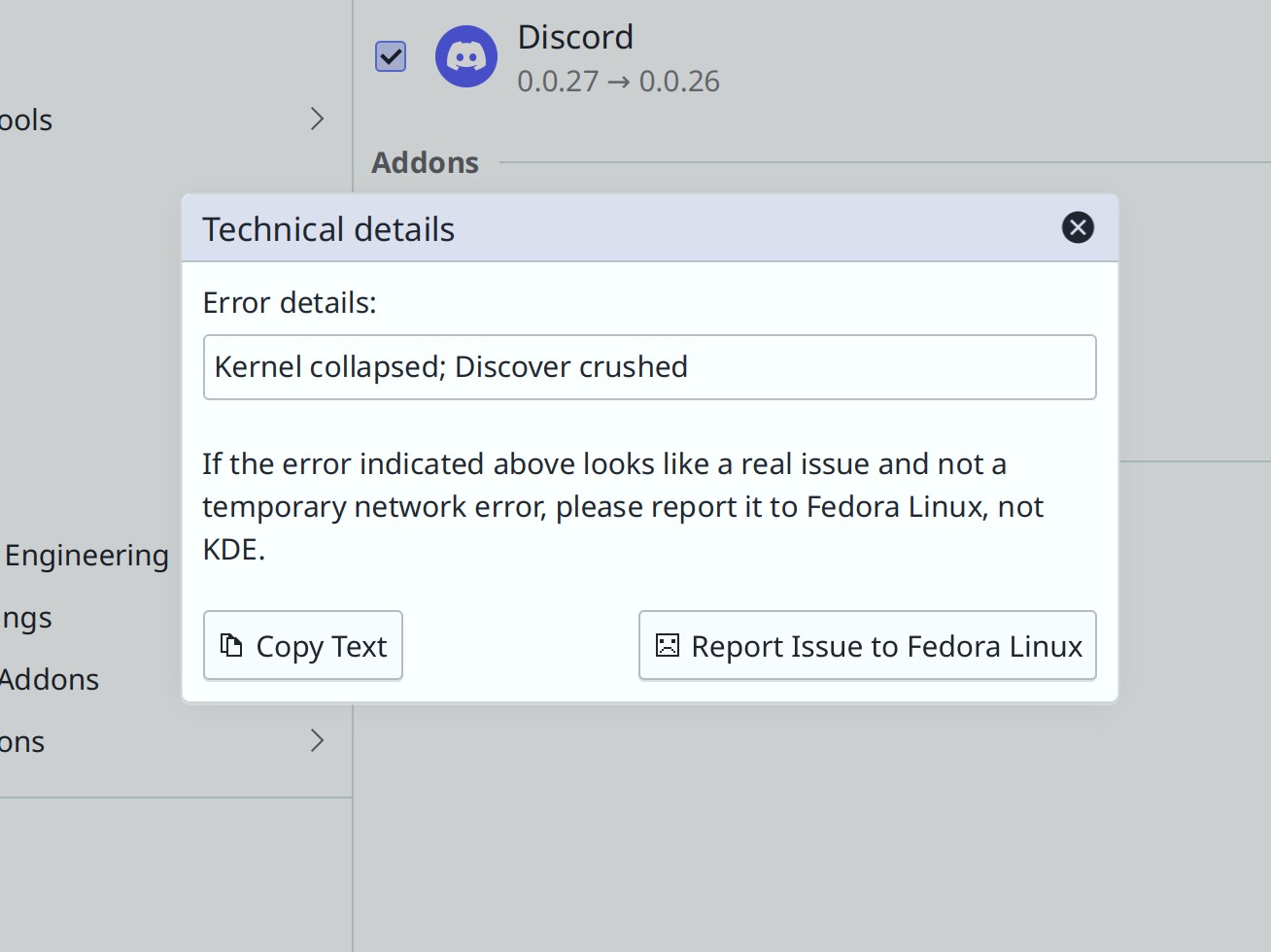
Okular now shows the “Digitally Sign” action at the top level of its hamburger menu, for faster access (me: Nate Graham, Okular 23.08. Link):
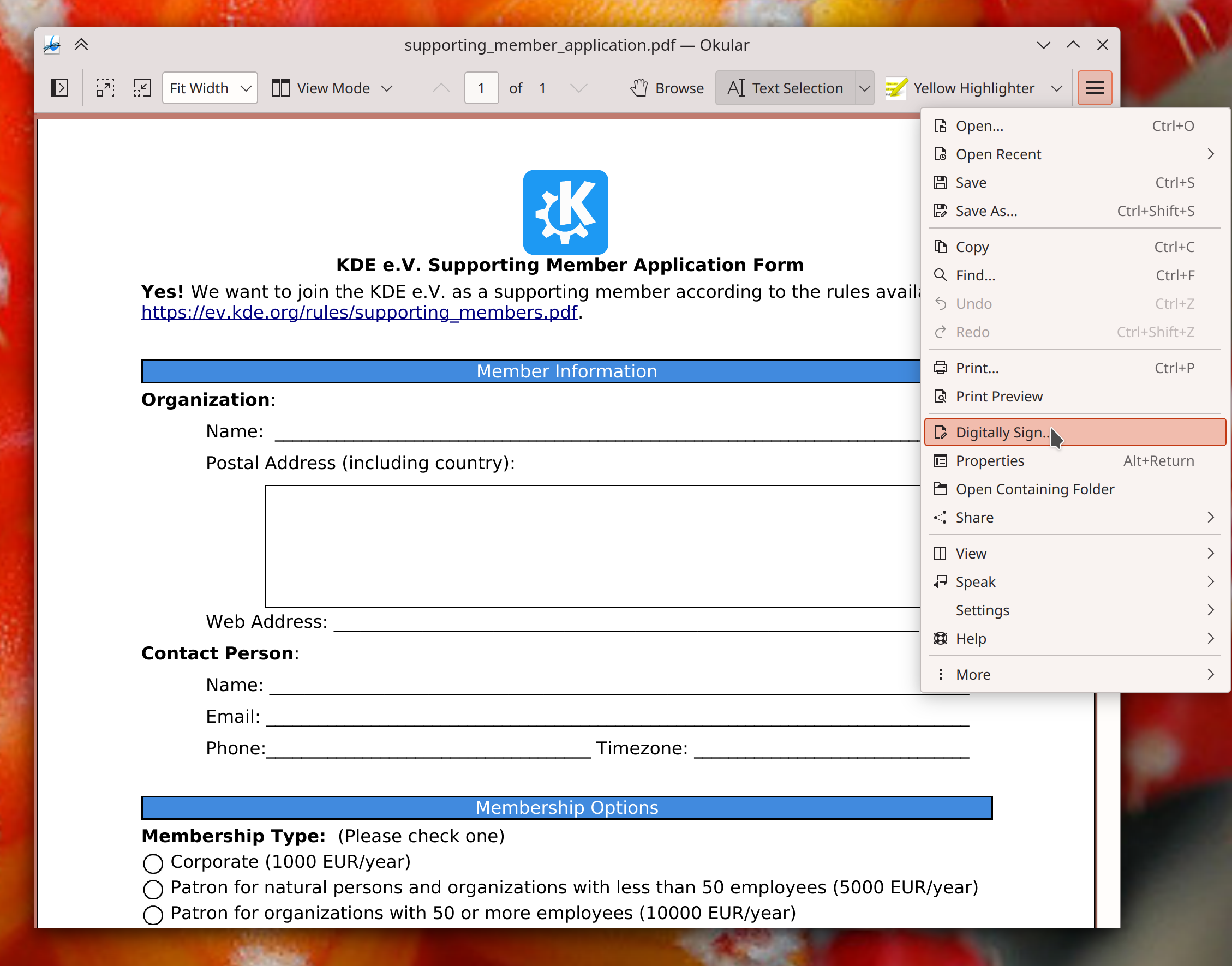
All the dialogs in System Monitor have been ported to use a newer Kirigami dialog component, which looks better and fixes a few layout issues (me: Nate Graham, Plasma 6.0. Link 1 and link 2):
Improved the responsiveness when hovering over items in Kickoff’s category list (Derek Christ, Plasma 6.0. Link)

Folder entries in System Settings’ File Search page now show their actual icons (Oliver Beard, Plasma 6.0. Link)

After being notified of a filename conflict in the save dialog, keyboard focus now immediately returns to the filename field so you can change the name to something else (Oliver Beard, Frameworks 5.107. Link)

Other Significant Bugfixes

(This is a curated list of e.g. HI and VHI priority bugs, Wayland showstoppers, major regressions, etc.)

In the Plasma Wayland session, fixed a source of Powerdevil crashes when screens are sleeping (Aleix Pol Gonzalez, Plasma 5.27.6. Link)

Fixed a source of excessively high CPU usage in Plasma caused by moving windows around (Fushan Wen, Plasma 5.27.6. Link)

In the Plasma wayland session, fixed some cursor handling bugs that could cause cursors to look wrong in XWayland apps (Severin von Wnuck, Plasma 5.27.6. Link 1 and link 2)

System Settings’ “Login Screen (SDDM)” page now shows errors in the UI again (me: Nate Graham, Plasma 5.27.6. Link)

Checking for updates in the PyCharm app no longer causes KWin to crash (Vlad Zahorodnii, Plasma 6.0. Link)

Other bug-related information of interest:

…And everything else

This blog only covers the tip of the iceberg! If you’re hungry for more, check out https://planet.kde.org, where you can find more news from other KDE contributors.

How You Can Help

If you’re a developer, please please please start living on Plasma 6 and fixing the bugs that you encounter. It’s long past the point where we should still be on Plasma 5! 6 is quite usable for daily driving (I’m doing so) and has lots of papercuts that need sorting out. A list of known issues that need fixing can be found at https://community.kde.org/Plasma/Plasma_6.

Otherwise, visit https://community.kde.org/Get_Involved to discover other ways to be part of a project that really matters. Each contributor makes a huge difference in KDE; you are not a number or a cog in a machine! You don’t have to already be a programmer, either. I wasn’t when I got started. Try it, you’ll like it! We don’t bite!

And finally, KDE can’t work without financial support, so consider making a donation today! This stuff ain’t cheap and KDE e.V. has ambitious hiring goals. We can’t meet them without your generous donations!

Call to Action: Easy porting opportunity in Plasma

This post is a Call To Action™ for those with the ability to set up a Plasma development environment and an interest in code hygiene. Plasma 6 development is in full swing, and we have an opportunity to make a difference by doing some relatively easy code porting. Read on if this intrigues you!


History

First, some background: For many years, Plasma has maintained forks of various Kirigami bits whose only purpose in life was to get colors from the active Plasma theme, rather than the systemwide color scheme. For example, Heading exists in both Kirigami, and also PlasmaExtras; they both do the same thing and are implemented the same way under the hood, but the PlasmaExtras version gets its colors from the active Plasma theme. If it didn’t, then when you used the Breeze Twilight theme, the text colors on your dark Plasma widgets would come from the systemwide light color scheme, be inappropriately dark, and you wouldn’t be able to see them.

Maintaining forks with minimal differences worked but wasn’t ideal, as they could–and sometimes did–drift subtly out of sync and cause maintenance headaches. It would be better if we could use the Kirigami versions in Plasma and have them substitute Plasma colors automatically. As of today, core Plasma developer Marco Martin has done just that for Plasma 6 with two patches!

Ultimately this will let us get rid of the forks, at least for components that don’t do any SVG styling (that’s planned too, but not ready yet).


How you can help

So with that out of the way, here’s how you can help: throughout Plasma (i.e., all repos in the Plasma group), submit merge requests with the following changes:

Replace this……with this:
PlasmaExtras.HeadingKirigami.Heading (Example merge request)
PlasmaCore.Theme.smallestFontKirigami.Theme.smallFont
PlasmaCore.Theme.NormalColorGroupKirigami.Theme.Window
PlasmaCore.Theme.mSize([default font]).heightKirigami.Units.gridUnit
PlasmaCore.Theme.[anything else]Kirigami.Theme.[the same thing]
PlasmaCore.ColorScope.colorGroupKirigami.Theme.colorSet
PlasmaCore.ColorScope.inheritKirigami.Theme.inherit
PlasmaCore.Units.largeSpacingKirigami.Units.gridUnit (due to a bug where PlasmaCore largeSpacing was too big; we need to change it to a Kirigami gridUnit to keep the expected sizing)
PlasmaCore.Units.devicePixelRatio1
PlasmaCore.Units.roundtoIconSize([height of the default font])Kirigami.Units.iconSizes.sizeForLabels
PlasmaCore.Units.roundtoIconSize([some integer value])Kirigami.Units.iconSizes.roundedIconSize([the same thing])
PlasmaCore.Units.[anything else]Kirigami.Units.[the same thing]

Quirks to be aware of

Make sure your master branch is up to date before you start looking at code, and also check to see if anyone else has already submitted a merge request. You don’t want to do work for nothing!

If any file with such changes made to it doesn’t already have a line near the top that says import org.kde.kirigami 2.20 as Kirigami, add it We can’t use Kirigami stuff without importing Kirigami!

If as a result of these changes to any particular file, nothing in it is still using PlasmaExtras or PlasmaCore anymore, you can also remove those import lines at the top.

Testing

Make sure to test your changes! Apply the changes to your Plasma 6 development build and restart. Then use the Breeze Light color scheme and the Breeze Dark Plasma theme and make sure all changed text is still readable, that anything using a small font size is still doing it correctly, that colors in general look correct, and that spacings and units look correct. You want to see no visual changes at all.

In the future

Later, we’ll also be able to port forked components that internally use Plasma-specific SVG theming. For example, PlasmaExtras.PlaceholderMessage is identical to Kirigami.PlaceholderMessage but it internally contains Plasma-specific labels and buttons that use Plasma SVG theming, rather than theming from the app style. We’re planning some more code wizardry so that the Kirigami versions of these components can dynamically substitute the internal Plasma SVG themed variants when run in Plasma. This isn’t ready yet, but when it is, I’ll announce another porting opportunity for folks who enjoyed (or missed out on) this one!

Tips & tricks: handwritten signatures in Okular

Today I’d like to share a tip about Okular, KDE’s flagship document reader app that’s eco-certified in Germany and used professionally around the world to secure documents.

Okular has robust support for digitally signing documents using a cryptographic signature, and it’s going to become even better soon. But what about signing documents using handwritten signatures, for those who live in places where digital signing hasn’t caught on yet?

Now, this is typically the point at which everyone who lives in a place where cryptographic signatures are common will chime in about how handwritten signatures are pointless and insecure. And they may be right, but it doesn’t matter because handwritten signatures are still used and considered valid in most of the world. And thankfully for people who live in any such part of the world, Okular turns out to support them pretty well.

The process involves some setup that you do once, and then after that’s done, the process of signing documents is suuuuuuuper simple. The time invested is worth it, trust me! So here’s how:

One-time setup process

First, you’ll need a piece of paper. Write your handwritten signature on it:

But, you know, for real

Next, scan it with SkanPage or take a picture of it with your phone and then transfer it to your computer using KDE Connect. You’ll end up with an image on your computer like this:

Open it up in Gwenview. Click the “Show Editing Tools” button in the toolbar to show the “Image Operations” sidebar. On this sidebar, click the “Crop” button and crop the image so that only the signature part is visible.

Then Click the “Adjust Colors” button:

Boost the contrast and brightness and reduce the gamma to make the background become completely white, and make the text look darker. But don’t make the text look completely 100% black; you want to preserve the appearance of real pen-strokes. It may take a bit of tweaking but keep at it! The end result will be something like this:

Now save this image somewhere on your computer using the PNG format–maybe in your Pictures or Documents folder. Don’t delete or move this image in the future!

Time to open up Okular. Go to the “Settings” menu and click “Configure Okular”. Then go to the “Annotations” page and click on the “Add” button:

A dialog window will appear. In this dialog window, give it the name “Insert Signature”, change the type to “Stamp”. Click on the little folder button next to the “Stamp Symbol” text field and navigate to the signature image file you just created:

If your file doesn’t appear in the “Open” dialog, that’s because you didn’t save it as a PNG. Re-save it as a PNG in Gwenview.

Click OK and you’re done!

Use it to sign a document

Now, the next time you have a document that needs signing, Open the annotations menu by clicking on the downward-pointing arrow next to the “Yellow Highlighter” toolbar button. Don’t click on the “Yellow Highlighter” text itself; click on the arrow next to it:

Now draw a box where you want the signature to be! There’s usually a “Date” field, so you can use the “Insert Text” annotation accessed from the same menu, and draw a similar box where you want the date to be. Enter the date when prompted.

Voila:

Easy as pie! Now you can do this almost instantly every time you have to sign a document.

This week in KDE: major plumbing work in Plasma 6

This week Plasma 6 underwent some major refactoring to the fundamental Plasma widget APIs to modernize them and make it harder to introduce errors when developing new widgets. Since almost everything in Plasma is a widget, this necessitated a lot of changes and QA. After a month of work, it’s now done! The user-facing side is nil (ideally nobody will notice anything), but there are some changes that developers will need to be aware of to port their widgets. Most widgets already needed to be ported anyway due to Qt changes, but hopefully this won’t add much else. A porting guide has already been written and can be found here. This work was done by Marco Martin, with me providing QA support.

On that subject, we got a lot more organized about Plasma 6 this week. We now centrally track status on a new wiki page that shows the outstanding issues and notable changes. I’m starting to feel like I see a light at the end of the tunnel! While I’ve had to use the X11 Plasma 6 session because the Wayland one is still a bit too unstable for me to feel productive, the X11 session now feels barely buggier than the Plasma 5 X11 session. It’s really quite nice at this point.

This came up in the comment threads of last week’s post, but the more people test and contribute to Plasma 6, the better the final release will be. Neon Unstable now offers Plasma 6 by default, making it a good testing platform for the adventurous. Especially if you have a heavily customized setup or use exotic hardware, please try it out and submit bug reports! Make sure to apply the “qt6” keyword to them.

User Interface Improvements

Many significant UI improvements to Skanpage, including drag-and-drop page re-ordering, better keyboard shortcuts, and better error reporting (Someone going by the pseudonym “John Doe”, Skanpage 23.08. Link)

Okular no longer bugs you when you save a document that was deleted on disk; it simply re-saves it as instructed (me: Nate Graham, Okular 23.08. Link)

The context menu actions of the Dictionary Widget are now more relevant and have icons (Laurent Montel, Plasma 6.0. Link):

Significant Bugfixes

(This is a curated list of e.g. HI and VHI priority bugs, Wayland showstoppers, major regressions, etc.)

KRunner no longer sometime crashes when trying to calculate certain math expressions, or simply when typing numbers in general (Max Ramanouski, Plasma 5.27.6. Link)

The final change just went in for making sure that Discover always gets the version numbers right for updatable Flatpak apps (Ismael Asensio, Plasma 5.27.6. Link)

When using a fractional scale factor in the Plasma Wayland session, you should no longer see line glitches all over the place (Matthias Dahl, Plasma 5.27.6. Link)

Fixed the “Add New Page” dialog in System Monitor to not be visually broken when using a language with longer translated strings than English (me: Nate Graham, Plasma 5.27.6. Link)

In the Plasma Wayland session, when adding a second keyboard layout, the Keyboard layout System Tray icon now appears immediately (Marco Martin, Plasma 6.0. Link)

Other bug-related information of interest:

Automation & Systematization

Overhauled the documentation about Plasma styles to be more up-to-date and accurate (Thiago Sueto, link)

Web presence

KDE’s growing assortment of “KDE for” pages has gotten a snazzy new landing page, and now it’s a top-level link over at kde.org (Carl Schwan):

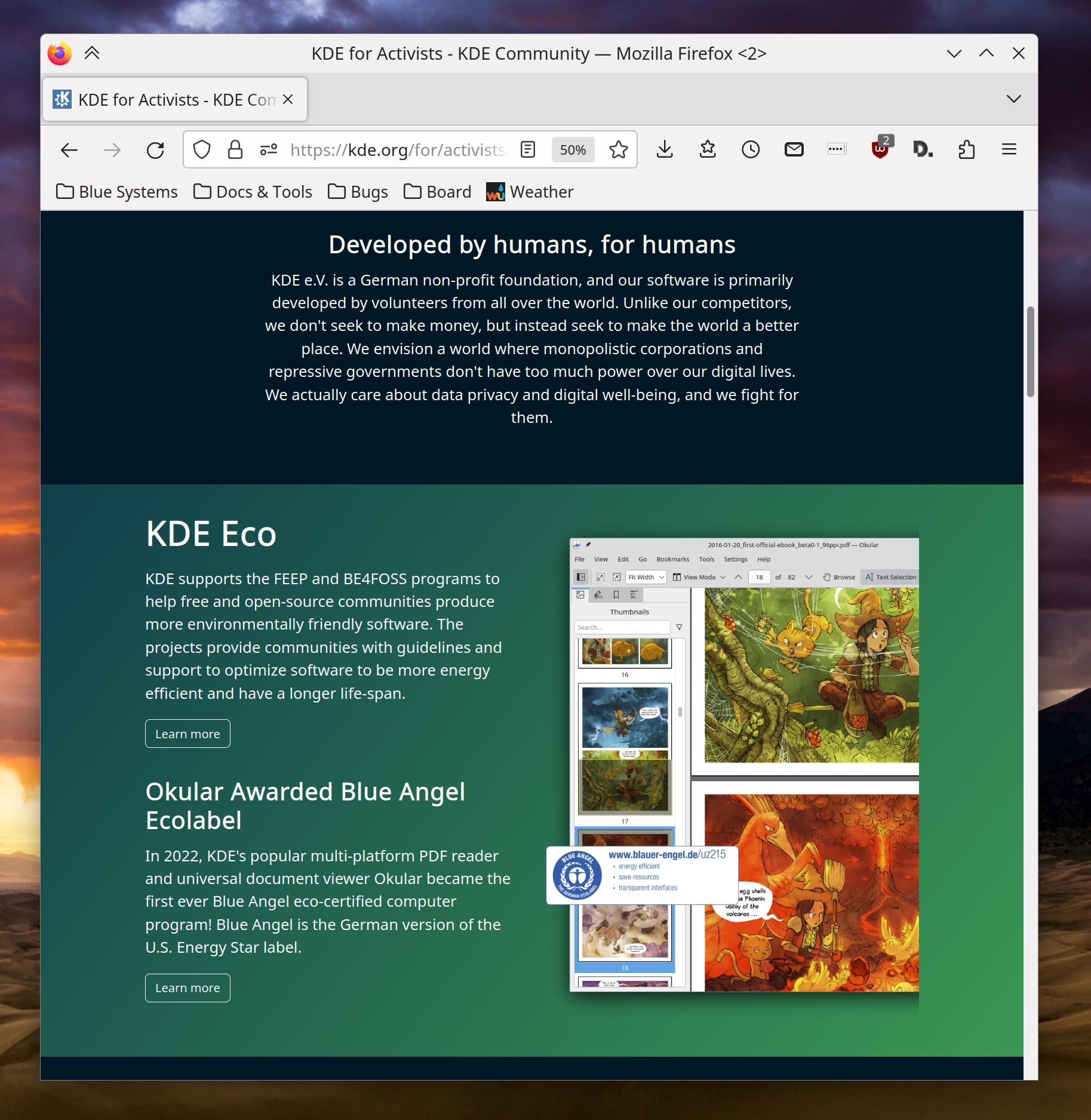
On top of that, there’s a new page: “KDE for Activists“, showcasing how KDE’s privacy-conscious communication can help you organize for what you believe in (Carl Schwan):

Note that this is a value-neutral statement; you can use KDE software to organize for whatever cause you believe in, no matter where on the political spectrum you consider yourself. Our software is neutral; it’s people who choose to use it for their purposes, and how. KDE software is used in homes, schools, businesses, news organizations, local governments, and, believe it or not, on both sides of the Russian invasion of Ukraine. People can take sides, but our software does not, so let’s try to keep the political battles out of the comments section of this post. Thanks everyone.

…And everything else

This blog only covers the tip of the iceberg! If you’re hungry for more, check out https://planet.kde.org, where you can find more news from other KDE contributors.

How You Can Help

If you’re a developer, please please please start living on a Plasma 6 session (not just building Plasma 6 stuff on top of Plasma 5) and fixing the bugs that you encounter. Plasma 6 is usable for daily driving, and I’m doing so, but it’s still very much in an alpha state and in need of work to make it releaseable.

If you’re an adventurous user, you can also use Plasma 6 with Neon Unstable. If you do so, make sure to submit bug reports for any problems you encounter, and apply the “qt6” keyword to them.

Otherwise, visit https://community.kde.org/Get_Involved to discover other ways to be part of a project that really matters. Each contributor makes a huge difference in KDE; you are not a number or a cog in a machine! You don’t have to already be a programmer, either. I wasn’t when I got started. Try it, you’ll like it! We don’t bite!

And finally, KDE can’t work without financial support, so consider making a donation today! This stuff ain’t cheap and KDE e.V. has ambitious hiring goals. We can’t meet them without your generous donations!

This week in KDE: for developers

Plasma 6 porting continues, with stability improving daily and new features and user interface improvements trickling in.

New Features

Okular now lets you choose the default scaling mode when printing PDFs (Martin Schnitkemper, Okular 23.08. Link)

Global Themes can now set the window decoration border size (me: Nate Graham, Plasma 6.0. Link)

User Interface Improvements

Gwenview’s color correction settings have been rephrased to be more comprehensible and correct (Adam Fontenot, Gwenview 23.08. Link)

Apps that have been marked as “Favorite” in Kickoff/Kicker/Application Dashboard/etc are now weighted more a bit more highly in KRunner-powered search results (Alexander Lohnau, Plasma 6.0. Link)

KRunner’s own search history no longer includes searches made in other KRunner-powered search tools such as Kickoff (Alexander Lohnau, Plasma 6.0. Link)

In the Clipboard widget, when you generate a QR code for some text, you can now drag it anywhere images can be dragged (Fushan Wen, Plasma 6.0. Link)

When a Flatpak app requests permission to run in the background, the way this is presented is now clearer and more user-friendly (Vlad Zahorodnii, Plasma 6.0. Link)

Metadata from Krita’s .kra files is now parsed, extracted, and displayed in “Details” views of the Properties Dialog, Dolphin’s Information Panel sidebar, etc (Joshua Goins, Frameworks 6.0. Link)

Other Significant Bugfixes

(This is a curated list of e.g. HI and VHI priority bugs, Wayland showstoppers, major regressions, etc.)

When using the optional ddcutil support in Powerdevil, changing the brightness via any of the current methods now prioritizes changing the brightness of a laptop’s built-in screen, rather than only adjusting the brightness of an external screen. Support for per-screen brightness control is being scoped out and may come in the future! (Quang Ngô, Plasma 5.27.6. Link)

Category names in Widget Explorer are once again translated (Alexander Lohnau, Plasma 5.27.6. Link)

Switching Global Themes or color schemes in System Settings no longer results in the “Appearance” category list item becoming temporarily invisible (Someone awesome, Plasma 6.0. Link)

Windows marked “Show on top” now remain where they are when the “Peek at Desktop” effect is invoked (Vlad Zahorodnii, Plasma 6.0. Link 1 and link 2)

Other bug-related information of interest:

Web presence

Another “KDE for” page has been created, this time showcasing what KDE can do for software developers! (Carl Schwan, right now! Link)

Changes not in KDE that affect KDE

In the Plasma Wayland session sidebars and docks provided by QDockWidget now work much better: it’s now re-dockable, and visually moved when dragged (David Redondo, Qt 6.6. Link)

…And everything else

This blog only covers the tip of the iceberg! If you’re hungry for more, check out https://planet.kde.org, where you can find more news from other KDE contributors.

How You Can Help

If you’re a developer, please please please start living on Plasma 6 and fixing the bugs that you encounter. It’s usable for daily driving (I’m doing so) but still very much pre-alpha and in need of work to get it into a releaseable state by the end of the year. We need your help!

Otherwise, visit https://community.kde.org/Get_Involved to discover other ways to be part of a project that really matters. Each contributor makes a huge difference in KDE; you are not a number or a cog in a machine! You don’t have to already be a programmer, either. I wasn’t when I got started. Try it, you’ll like it! We don’t bite!

And finally, KDE can’t work without financial support, so consider making a donation today! This stuff ain’t cheap and KDE e.V. has ambitious hiring goals. We can’t meet them without your generous donations!

This week in KDE: Night color on Wayland with NVIDIA

This week probably the biggest news is that in Plasma 6, the Night Color feature will work as expected on Wayland when you’re using an NVIDIA GPU! Because NVIDIA’s drivers don’t support the necessary Gamma LUT features to make it work in an optimal way as on Intel and AMD GPUs, we had to use a slightly different approach that isn’t quite as efficient. But hopefully that’s better than not having the feature work at all, and if you care about the increased resource usage, you’re welcome to not use the feature. This work was done by Xaver Hugl. Thanks, Xaver!

User Interface Improvements

KRunner search results for very short 2 and 3 character strings should be a bit better and more relevant now (Alexander Lohnau, Plasma 5.27.6. Link)

System Settings’ sidebar now has better keyboard navigation, and lets you use the arrow keys instead of the tab keys if you’d prefer or if you’re using a device with a d-pad and no obvious tab key (Ivan Tkachenko, Plasma 5.27.6. Link)

In the Plasma Wayland session, when you activate a KWin effect with a touchpad gesture in a certain direction, the opposite gesture now deactivates it (Aleix Pol Gonzalez, Plasma 6.0. Link)

System Settings’ File Search page has gotten a visual overhaul and now looks nicer (me: Nate Graham and Helden Hoierman, Plasma 6.0. Link):

The tooltips showing window previews in the Task Manager no longer time out on their own while the cursor remains hovering over a Task, just like the behavior of other tooltips elsewhere (me: Nate Graham, Plasma 6. Link)

Other Significant Bugfixes

(This is a curated list of e.g. HI and VHI priority bugs, Wayland showstoppers, major regressions, etc.)

Spectacle’s sidebar is no longer too narrow to accommodate long button text in some languages (Yoann Laissus, Spectacle 23.04.2. Link)

When using a horizontal bottom panel, Task Manager tooltip window thumbnails no longer sometimes appear in the wrong location (Bharadwaj Raju, Plasma 5.27.6. Link)

In the Plasma X11 session, dragging files to Task Manager Tasks in such a manner that you end up right-clicking while still dragging no longer sometimes causes drag-and-drop to just break (Fushan Wen, Plasma 5.27.6. Link)

In the Plasma Wayland session, some blurred and transparent Breeze-themes context menus no longer sometimes exhibit weird visual glitches (Mouse Zhang, Plasma 5.27.6. Link)

When KDE apps are run in dark mode on non-Plasma desktops where the plasma-integration package isn’t installed, Breeze icons will now correctly use light colors instead of staying dark and becoming unreadable (Jan Grulich, Frameworks 5.107. Link)

When your system is set up with an encrypted home directory, file and folder thumbnails will now be stored in their typical cache location in your homedir, preventing them from having to be re-generated every single time (Payton Quinn, Frameworks 5.107. Link)

Other bug-related information of interest:

Automation & Systematization

Now that tons and tons of KDE projects use JSON files to describe their metadata, there’s now a JSON file validator CI job that will prevent silly errors (Alexander Lohnau, right now. Link)

…And everything else

This blog only covers the tip of the iceberg! If you’re hungry for more, check out https://planet.kde.org, where you can find more news from other KDE contributors.

How You Can Help

If you’re a user, upgrade to Plasma 5.27! If your distro doesn’t offer it and won’t anytime soon, consider switching to a different one that ships software closer to its developer’s schedules.

If you’re a developer, please please please start living on Plasma 6 and fixing the bugs that you encounter. It’s usable for daily driving (I’m doing so) but still very much pre-alpha and in need of work to get it into a releaseable state by the end of the year.

Otherwise, visit https://community.kde.org/Get_Involved to discover other ways to be part of a project that really matters. Each contributor makes a huge difference in KDE; you are not a number or a cog in a machine! You don’t have to already be a programmer, either. I wasn’t when I got started. Try it, you’ll like it! We don’t bite!

And finally, KDE can’t work without financial support, so consider making a donation today! This stuff ain’t cheap and KDE e.V. has ambitious hiring goals. We can’t meet them without your generous donations!

Presentation at University of Macedonia: Making a Difference

Today I had the honor of delivering a virtual presentation with fellow KDE contributor Neofytos Kolokotronis at the University of Macedonia, the site of KDE’s 2023 Akademy conference. The subject was “Making a Difference: How to contribute and jump start your career in Free Software with the KDE Community”, making it especially relevant for those who have been looking to get started contributing to KDE and don’t yet know how. But even if you’re a seasoned KDE contributor, I bet you’ll learn a thing or two about KDE’s storied history or ambitious plans!

Check it out:

This week in KDE: Preliminary HDR support

KWin developer Xaver Hugl put a lot of work into HDR support in KWin during the recent HDR hackfest and Plasma sprint, and as a result, the first parts have now been merged for the Plasma 6.0 Wayland session! This also lays the groundwork for color management on Wayland. It’s an interesting and complex subject, so if you’d like to know more, check out Xaver’s excellent blog post on the subject.

While you’re here, let me also do a bit of self-promotion. Fellow KDE contributor Neofytos Kolokotronis and I will be giving a virtual pre-Akademy talk at the University of Macedonia in a few days, on May 23rd. Learn more and register here!

New Features

Skanpage now exposes scanner-specific adjustment options like for brightness, contrast, gamma, and color balance (Someone still going by the pseudonym “John Doe”, Skanpage 23.08. Link)

Konsole now has a new “Monitor for prompt” feature that can be used to send a notification once a long-running task finishes (Matan Ziv-Av, Konsole 23.08. Link)

Kate’s LSP client support now supports the GLSL language (Marián Konček, Kate 23.08. Link)

Just like with volume adjustments (announced last week), you can now hold down the Shift key while adjusting the brightness to adjust it in 1% increments for finer control (Fushan Wen, Plasma 6.0. Link 1 and link 2)

You can now apply file associations’ app ordering priorities to other file types in bulk (Marco Rebhan, Plasma 6.0. Link)

"Apply to..." dialog to apply app orderings for one file type to other file types as well

User Interface Improvements

Kate’s Debugger plugin has received various enhancements: interactive GDB navigation buttons in its toolview, a configuration window, and a clearer name (Akseli Lahtinen, Kate 23.08. Link 1, link 2, and link 3)

For those of you who were using the fact that Gwenview appears in its own “Open With” menu to open the current image in a new window, there’s now a new “Open in New Window” feature that does the same thing in a fully supported way (Eugene Popov, Gwenview 23.08. Link)

The Magic Lamp window minimizing effect now works and looks better with floating panels, hidden panels, and multi-screen arrangements (Vlad Zahorodnii, Plasma 5.27.6. Link 1, link 2, and link 3)

When tiling windows, the gap value you choose now affects the gap between windows, not just between windows and screen edges (Ismael Asensio, Plasma 5.27.6. Link)

System Settings’ Activities page has been ported to QML and given a small visual overhaul in the process (Ismael Asensio, Plasma 6.0. Link):

System Settings window showing Activities page with clean modern design

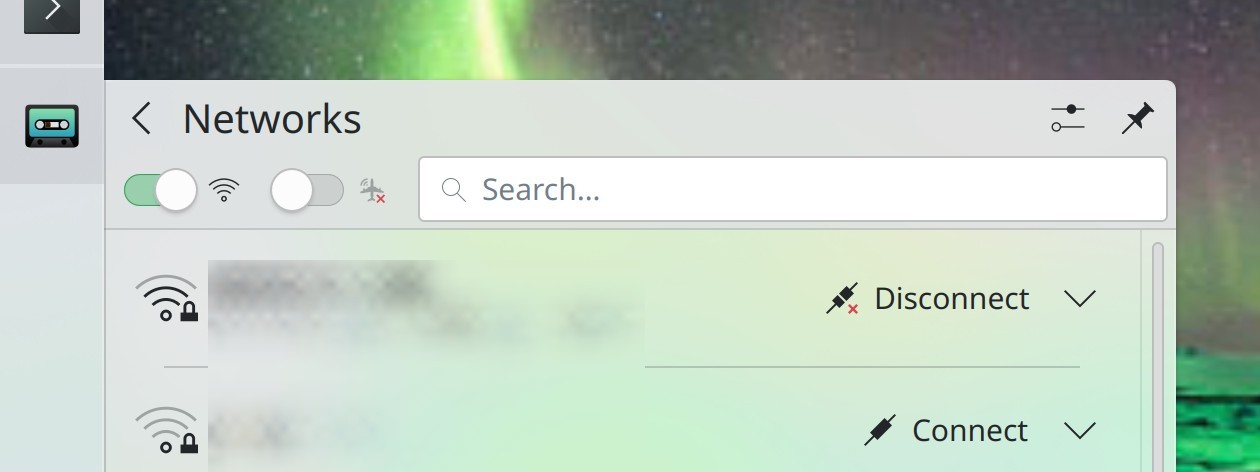
We now use Switches instead of checkboxes for “instant apply” and “on/off” style actions in Plasma widgets, such as the Networks and Bluetooth widgets (Niccolò Venerandi and me, Nate Graham, Plasma 6.0. Link 1, link 2, and link 3):

Networks widget showing switches rather than checkboxes in header area

Now that single-clicking on a desktop in the Overview Effect’s desktop bar only switches desktops with the effect, double-clicking it will now switch desktops and then exit the effect (me: Nate Graham, Plasma 6.0. Link)

Dolphin no longer shows a free space capacity bar for read-only volumes, because for those it isn’t very actionable (Kai Uwe Broulik, Frameworks 6.0 Link)

Significant Bugfixes

(This is a curated list of e.g. HI and VHI priority bugs, Wayland showstoppers, major regressions, etc.)

When Dolphin is configured to remember open tabs on launch, this now works again after it broke recently during the process of fixing a different bug (Méven Car, Dolphin 23.04.2. Link)

Gwenview’s “Open With” menu once again always opens the actual app you specified instead of a different one, after we broke this by removing Gwenview from its own menu, oops (Gwenview 23.04.2. Link)

The Properties dialog for files and folders on the desktop now shows its “Details” tab as expected (Méven Car, Dolphin 23.08. Link)

The “Software Sources” button on Discover’s Settings page now actually works (Aleix Pol Gonzalez, Plasma 5.27.6. Link)

Discover finally shows the versions of updated Flatpak apps in the correct order, for real this time (Aleix Pol Gonzalez, Plasma 5.27.6. Link)

Discover will no longer sometimes show a mysterious error message saying “No metadata URIs for vendor directory” (Aleix Pol Gonzalez, Plasma 5.27.6. Link)

When using a Global Menu, GTK apps now display their menus correctly right after being launched, with no re-focus required (Severin von Wnuck, Plasma 5.27.6. Link)

The global “Window to Next/Previous Screen” actions now send windows to the correct screens again (Natalie Clarius, Plasma 5.27.6. Link)

When using icons themes with non-monochrome action icons, various icons in various Kirigami-based apps are no longer sometimes inappropriately rendered in all black (Alexander Volkov, Frameworks 5.107. Link)

Other bug-related information of interest:

…And everything else

This blog only covers the tip of the iceberg! If you’re hungry for more, check out https://planet.kde.org, where you can find more news from other KDE contributors.

How You Can Help

If you’re a user, upgrade to Plasma 5.27! If your distro doesn’t offer it and won’t anytime soon, consider switching to a different one that ships software closer to its developer’s schedules.

If you’re a developer, please please please start living on Plasma 6 and fixing bugs. It’s usable for daily driving (I’m doing so) but still very much pre-alpha and in need of work to get it into a releaseable state by the end of the year.

Otherwise, visit https://community.kde.org/Get_Involved to discover other ways to be part of a project that really matters. Each contributor makes a huge difference in KDE; you are not a number or a cog in a machine! You don’t have to already be a programmer, either. I wasn’t when I got started. Try it, you’ll like it! We don’t bite!

And finally, KDE can’t work without financial support, so consider making a donation today! This stuff ain’t cheap and KDE e.V. has ambitious hiring goals. We can’t meet them without your generous donations!

These weeks in KDE: no more hidey-hidey authentication dialog games

In addition to the changes made and announced during the recent Plasma Sprint at Tuxedo Computers’ offices in Augsburg, lots of other things have been brewing as well!

New Features

Kate now supports Godot Engine’s Language Server Protocol (Michael Alexsander, Kate 23.08. Link)

In Okular, you can now copy an annotation’s text to the clipboard using the context menu for the annotation’s entry in the annotations sidebar list (Kai Uwe Broulik, Okular 23.04. Link)

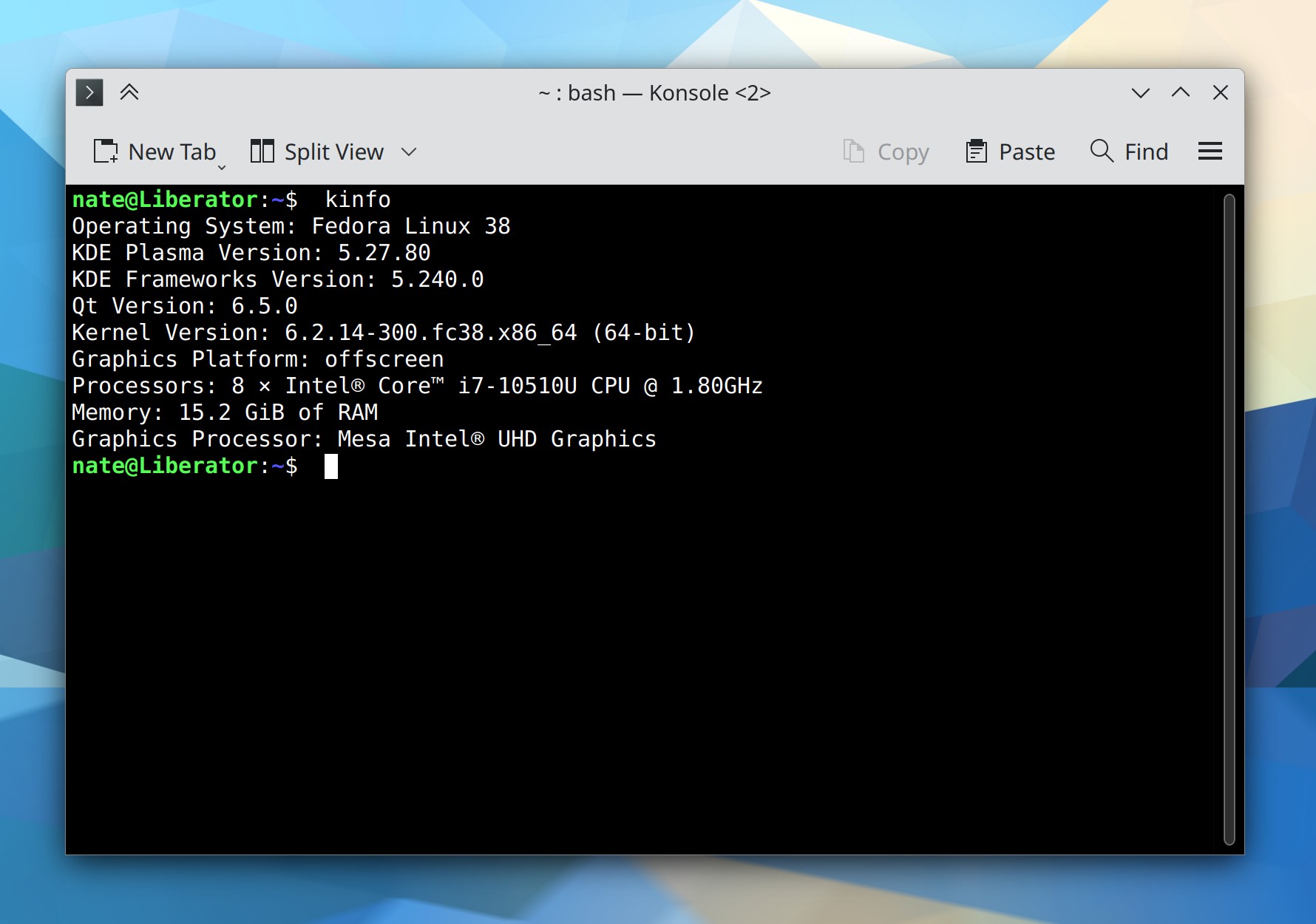
There is now a new kinfo command you can run to dump versions numbers of various software components on the command line, which can be useful for debugging and bug reporting purposes. It displays the same information that’s in Info Center’s “About This System” page (Harald Sitter, Plasma 5.27.5. Link):

KDE Konsole terminal window showing output of the `kinfo` command

To save energy, while the screen is locked, your monitors now turn off sooner than they do when unlocked. This is configurable and defaults to 60 seconds (Méven Car, Plasma 6.0. Link)

You can now middle-click on a color circle in the Plasma Color Picker widget to copy the color code text to the clipboard (Fushan Wen, Plasma 6.0. Link)

You can now hold down the Shift key while adjusting the volume by using a global shortcut or scrolling over the Audio Volume widget to adjust it in 1% increments for finer control (Fushan Wen, Plasma 6.0. Link)

User Interface Improvements

In Spectacle’s annotation UI, it’s now as easy as it was in the 22.12 release to draw a shape with an outline but no fill–for example to draw a perfect circle around something to call attention to it (Noah Davis, Spectacle 23.04.1. Link)

Significantly improved scrolling performance in Elisa when there are a lot of songs in the playlist (Nicolas Fella, Elisa 23.04.1. Link)

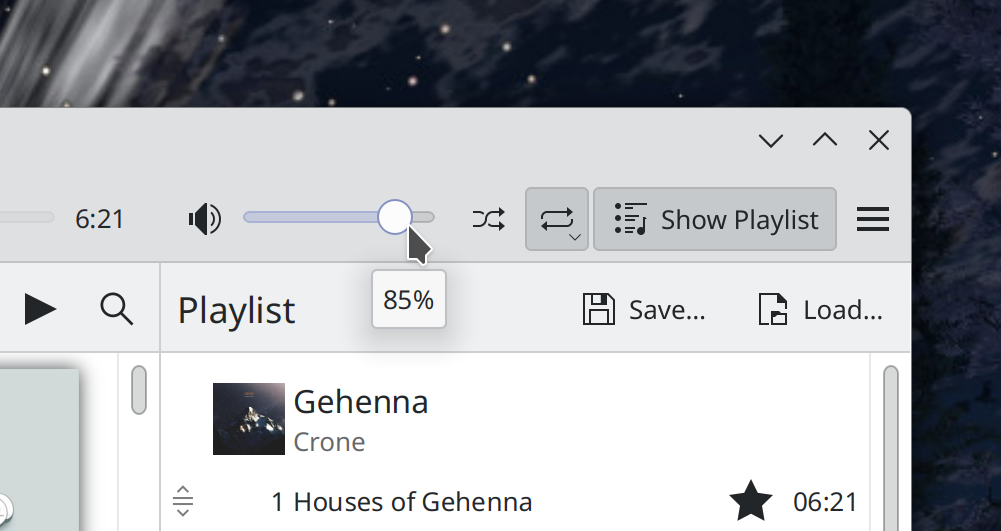
Dragging the volume slider in Elisa now shows a tooltip indicating its current level (Jack Hill, Elisa 23.08. Link):

Elisa main window showing volume level tooltip that says "85%" below volume slider

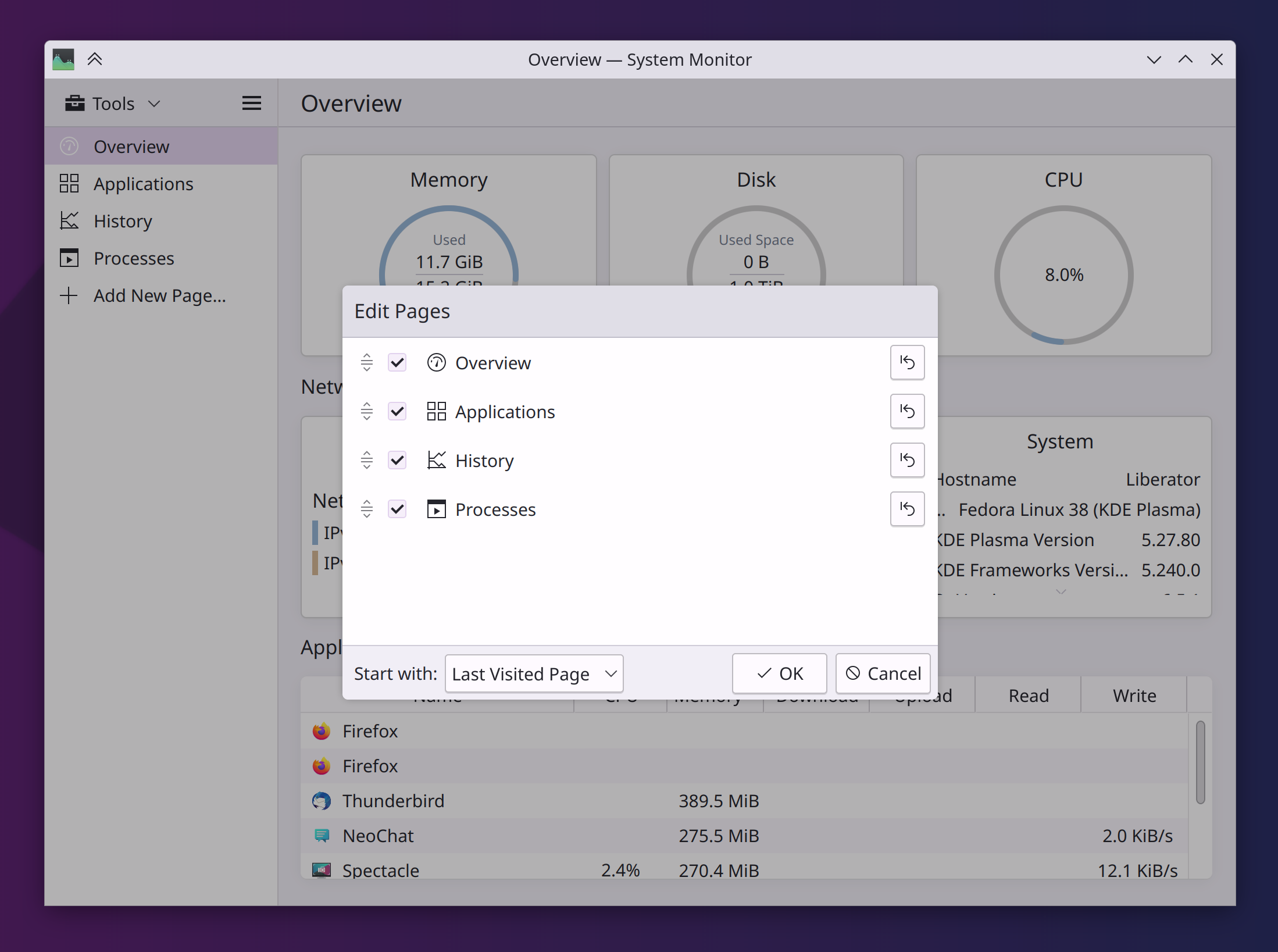
Discover now tries even harder to point you in the first direction (i.e. towards your distro) when there’s an update issue (me: Nate Graham. Plasma 6.0. Link):

Oh look, Discord’s version numbers are reversed again. But this time it wasn’t Discover’s fault and Flathub was actually the culprit!

The thick vertical lines in the Notifications widget no longer look weird with using various non-default Plasma themes, including Oxygen (me: Nate Graham, Plasma 5.27.5. Link)

When an app is forcing Do Not Disturb mode to be enabled, its explanatory text will no longer sometimes show end times in the past (Nicola Smaniotto, Plasma 5.27.5. Link)

In KRunner and other KRunner-powered searches, when the search term matches the starting text of both apps and files, apps are now prioritized (Alexander Lohnau, Plasma 5.27.5. Link)

When you switch Virtual Desktops in the Overview effect by clicking on one of them on the strip at the top, it will now switch to that desktop within the Overview effect itself, and not close immediately (Vlad Zahorodnii, Plasma 6.0. Link)

When you view the QR code for a connected network, it now appears inline in the widget, rather than in a giant full-screen overlay (Kai Uwe Broulik, Plasma 6.0. Link)

In the Breeze Icons theme, the small monochrome versions of the “MS DOS Executable” icons now respect your active color scheme as expected (Michael Alexander, Frameworks 5.106. Link)

The icons shown in the Display Configuration widget and OSD now have consistent stroke widths and levels of detail (me: Nate Graham and Noah Davis, Frameworks 5.106. Link)

Significant Bugfixes

(This is a curated list of e.g. HI and VHI priority bugs, Wayland showstoppers, major regressions, etc.)

In Okular, it’s now possible to “Save As…” when your document has been externally modified or deleted, so you can avoid losing any unsaved changes (me: Nate Graham, Okular 23.04.1. Link)

The authentication window will no longer sometimes appear behind the window that requested it, as would often happen when launching Partition Manager (Harald Sitter, Plasma 5.27.5. Link)

In the Plasma Wayland session, fixed a bug that could cause Plasma to repeatedly crash on login with certain combinations of settings (David Redondo, Plasma 5.27.5. Link)

In the Plasma Wayland session, text copied in an app while Klipper is running with sane regular settings is now still paste-able after quitting that app (Tobias Fella, Plasma 5.27.5. Link)

On System Settings’ Night Color page, the text telling you what will happen is no longer truncated when the page is scrollable (me: Nate Graham and Natalie Clarius, Plasma 5.27.5. Link)

In the Plasma Wayland session, basic sticky keys functionality now works! (Nicolas Fella, Plasma 6.0. Link 1, link 2, and link 3)

In the Plasma Wayland session, kinetic scrolling in GTK now works (Vlad Zahorodnii, Plasma 6.0. Link)

In the Plasma Wayland session, searching for the clipboard contents in KRunner with the Alt+Shift+F2 shortcut now works (Ismael Asensio, Plasma 6.0. Link)

Other bug-related information of interest:

Automation & Systematization

Added an autotest for doing modesets in KWin (Xaver Hugl, Plasma 6.0. Link)

Changes not in KDE that affect KDE

When using the Systemd-enabled Plasma boot sequence (which has been the default setting for a year or two), apps set up to autostart will no longer fail to autostart if their .desktop file happens to contain the X-GNOME-Autostart-Phase key (David Edmundson, Systemd 254. Link)

PDFs digitally signed in Okular no longer become locked in Adobe Acrobat such that no one else can sign them (Nicolas Fella, sponsored by TU Dresden, Poppler 23.05.0. Link)

…And everything else

This blog only covers the tip of the iceberg! If you’re hungry for more, check out https://planet.kde.org, where you can find more news from other KDE contributors.

How You Can Help

If you’re a user, upgrade to Plasma 5.27! If your distro doesn’t offer it and won’t anytime soon, consider switching to a different one that ships software closer to its developer’s schedules.

If you’re a developer, consider working on known Plasma 5.27 regressions, or compile Plasma 6 and start working on outstanding issues and porting tasks. You might also want to check out our 15-Minute Bug Initiative. Working on any of these topics makes a big difference quickly!

Otherwise, visit https://community.kde.org/Get_Involved to discover other ways to be part of a project that really matters. Each contributor makes a huge difference in KDE; you are not a number or a cog in a machine! You don’t have to already be a programmer, either. I wasn’t when I got started. Try it, you’ll like it! We don’t bite!

And finally, KDE can’t work without financial support, so consider making a donation today! This stuff ain’t cheap and KDE e.V. has ambitious hiring goals. We can’t meet them without your generous donations!