I’m on Patreon now

Howdy everyone! So many folks have asked me to set up a Patreon page that I’ve gone and done it: https://www.patreon.com/ngraham

By supporting me on Patreon, you’re helping me provide the focus, direction, support, and technical contributions that work to turn the KDE software suite into a lean, mean, bug-free productivity machine, and get it distributed well so that our users have great options for getting our software.

Of course, I’m only one man; what really matters is not me, but rather you! KDE’s greatest strength is its passionate community of developers and users, who work tirelessly to develop, improve, polish, promote, and use KDE software. I truly couldn’t do this without all of you, and in fact, I wouldn’t even want to! All of you are the reason why I work so hard on KDE software. Thank you, so very much.

Become a patron

This week in Discover (and Kirigami!), part 6

This is going to be a double-header: today we’re discussing Discover as well as Kirigami–KDE’s UI framework that facilitates writing convergent apps that look and feel good on both the desktop and a mobile device.

…At least that’s the idea. The truth is, KDE users have voiced a lot of criticism for how well this works out in practice. An especially common complaint is that the desktop user experience gets short shrift, and Kirigami apps feel like big phone apps.

We’ve heard this feedback, and we’re acting on it. Over the past week, we’ve been hard at work to make Kirigami UI components behave more appropriately on the desktop, and have Discover make use of them instead of its custom components.

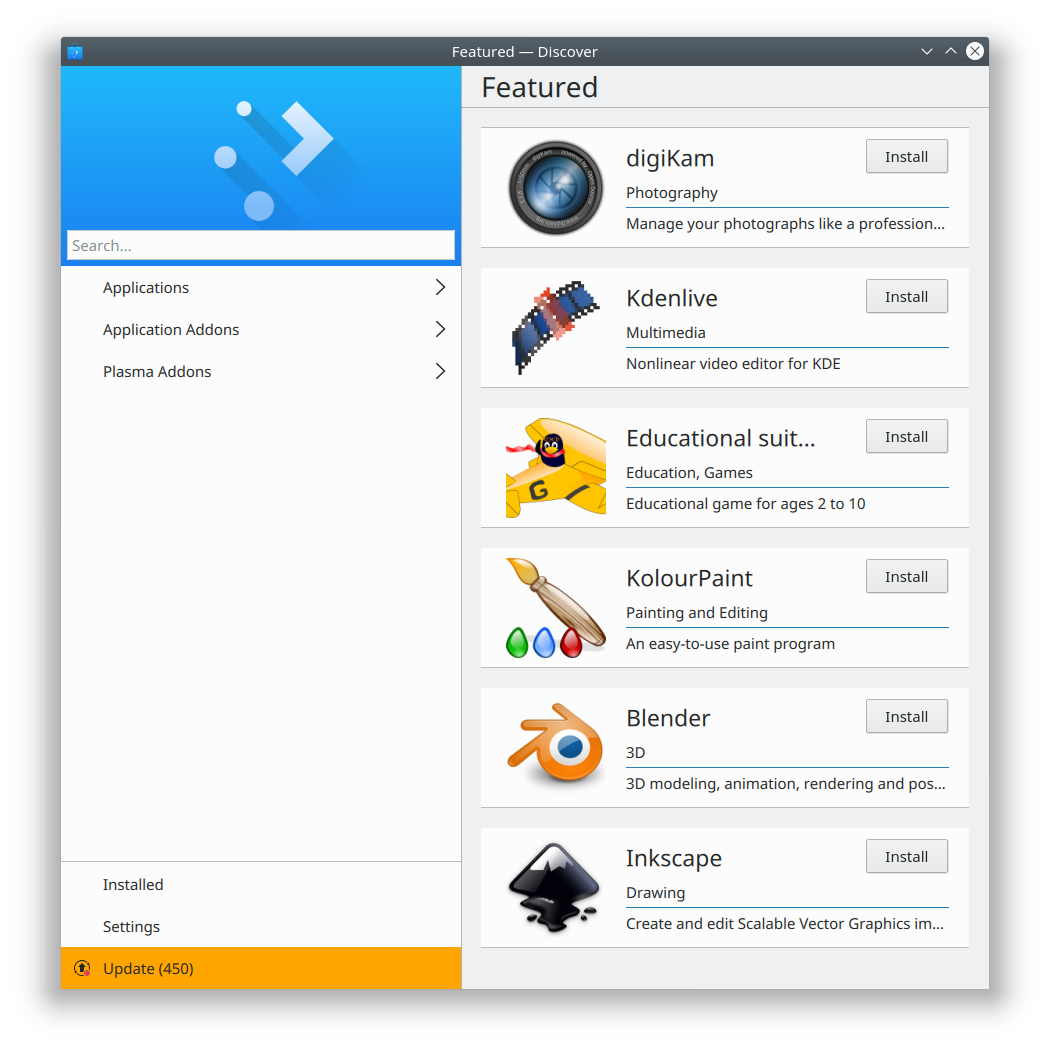
So I have exciting news for everyone who has complained about Discover’s design being too mobile-ey and wasting too much space: that’s going to be a thing of the past. Here’s how the Featured page now looks in git master:

No more huge header with the picture of the coffee cup that nobody liked! This is not the final appearance; there’s still polish work to be done, and we are heavily iterating over Kirigami to improve it to make the Desktop UI a first-class citizen. But it’s a model for what we’re going for.

We also added some other much-requested user-centric features to Discover, such as making reviews more prominent. Have a look!

  • Discover now shows the top three reviews right on the app page (KDE bug 380514, implemented in KDE Plasma 5.13):
  • Discover’s review submission pop-up is now more user-friendly and makes it impossible to accidentally submit a one-star review (KDE bug 390426 and Phabricator revision D10500, improved in Plasma 5.13):
    Note the presence of a close button! Another much-requested feature for Kirigami pop-ups.
  • You can now use Discover to write an app’s first review (KDE bug 390339 and KDE Phabricator revision D10476, fixed in KDE Plasma 5.12.1):
  • Kirigami scrollable pop-ups (used for Discover’s review page) no longer let you scroll beyond the content in desktop mode (KDE bug 388942, fixed in KDE Frameworks 5.44)
  • Kirigami non-scrolling pop-ups (used for Discover’s review input pop-up) now have correct bottom padding (KDE bug 390032, fixed in KDE Frameworks 5.44)
  • Kirigami toolbar headers are bit taller their titles and navigation buttons have appropriate padding (KDE Phabricator revisions D10483 and D10524, fixed in KDE Frameworks 5.44)
  • Kirigami pop-ups (used for Discover’s screenshots and reviews pop-ups) now have close buttons (KDE bug 387815, Fixed in KDE Frameworks 5.44)
  • Discover’s “show more reviews” button now always shows the correct number of reviews, has slightly better text, and no longer lets you write the first review for apps that you haven’t installed yet (KDE Phabricator revisions D10527 and D10525, Fixed in KDE Plasma 5.13)
  • Items in app lists now have better top padding, so they don’t touch the header (KDE Phabricator revision D10548)
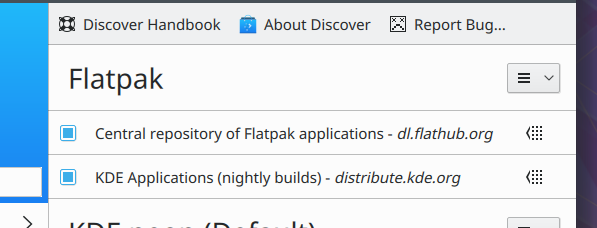
  • Improved the metadata for the KDE Nightly Builds Flatpak repo so it has a more appropriate name, in preparation for encouraging our users to try it out (more on that soon…):

Well there you have it. We never stop working on improving Discover, and we really do listen to user feedback. Mark my words, Discover is going to become one of the most-loved Linux software centers, you heard it here first! Help is always appreciated, so feel free to start contributing and making a difference to a project that truly matters. You don’t have to be a programmer to have an impact!

And if you look at my efforts and like what you see, consider donating on Patreon to help me do it full-time, rather than squeezing it in before and after my regular job. With your support, I could bring forth even more for KDE!

Plasma 5 perfection: call for development

Igor Ljubuncic of Dedoimedo is at it again, and has just published a list of high-profile KDE Plasma bugs and papercuts. As a Plasma fan, his intention is to call attention rather than criticize, and I’ve put together a response for every issue he raised. For the full list, scroll down.

Here’s the thing: reporting issues is important. QA is important. Raising awareness of problems is important. But as you’ll see from the list below, nearly every legitimate issue that Igor brings up is already known and tracked in Bugzilla. Many are already fixed, in fact.

The problem is lack of resources, not lack of awareness of issues. Fixing bugs requires developers. And we need more in order to fix them all at the rapid pace that our users expect. We know about the bugs. We want to fix the bugs. But we need your help to do it!

The best way is to start submitting some patches. You don’t even need to know any programming! Here is a non-programming patch I submitted just today, for example. A lot of my patches are utterly trivial in nature, like this one or this one. These are easy fixes; low-hanging fruit. Anyone with some technical knowledge can get started today! There’s a ton of support.

If you want to help propel KDE to the great heights it’s capable of, climb on board!

And now, for the full list, if you dare:

  • [C] Widget button on the left side is too close to the desktop folders.

    Will be fixed soon: https://phabricator.kde.org/D10563

  • [C] Widgets list always opens on the left side, regardless of the button placement.

    This isn’t a bug. The widget list can be opened from multiple interfaces; if it always followed the Desktop Toolbox, it would just be inconsistent with something else. Still, we may be able to make some usability improvements: https://bugs.kde.org/show_bug.cgi?id=390575

  • [C] Wireless icon (when not connected) is too pale and may be mistaken for a gap in the system area in the panel.

    Already fixed; see https://bugs.kde.org/show_bug.cgi?id=384018

  • [C] When connecting to a Wireless network, the user may be prompted for password twice, which is probably related to the KDEWallet service.

    See https://bugs.kde.org/show_bug.cgi?id=387502. This is mostly up to distros; most of them don’t configure KWallet properly. Kubuntu already does for the actual user account, but doesn’t for the live session. But it will soon; see https://phabricator.kde.org/T7981

  • [F] When you add/pin applications to the task manager, the menu auto-closes. This is annoying and distracting if you want to add more than one icon at a time.

    See https://bugs.kde.org/show_bug.cgi?id=390585

  • [F] Menu session end buttons all have the same result, regardless of what you click on. Whether you choose suspend, reboot or shutdown, you still have a 30-sec timeout screen with the same options presented again. A confirmation is nice, but it should also correlate to the chosen action. Clicking suspend or reboot and then choosing shutdown a few seconds later negates the first choice.

    It already does; the action you chose is the one that’s selected in the confirmation screen.

  • [C] The system menu does not differentiate between several versions of the same application, if installed. For example, the standard repo and the snap version of VLC 3.0 both show exactly the same, and the only way to tell them apart is by the icon (lower-res for the snap), or alternatively, by launching the program to check which version it is.

    See https://bugs.kde.org/show_bug.cgi?id=389035

  • [F] The order of different versions of the same application as listed in the system menu changes based on usage/launches.

    That’s a feature, not a bug. For an app list based on frequency of use, you should expect each version of an app to appear separately and have its own ordering. If you didn’t care about them being separate, you wouldn’t install multiple versions of the same app.

  • [C] Panel height resize is done using a drag/slider rather than a precise input value. Both options ought to exist, so that both methods can be used. Hand sliding, especially without an external mouse pointer, is tedious and inaccurate.

    Improved with https://bugs.kde.org/show_bug.cgi?id=372364. Further improvements possible.

  • [C] Brightness slider does not go all the way to the right on the 100% mark.

    Already fixed, a long time ago (Igor even blogged about it having been fixed!). Must have been using a distro with an old version of Plasma, or a defective theme.

  • [C] The clipboard in the system area, after you copy media files, does not have a perfect vertical alignment, leading to the bottom-most line to be partially obscured (cropped).

    Not a bug; this is how all scrollable lists work everywhere. Perfect alignment is impossible when the list can be filled with arbitrarily-sized content.

  • [F] Default font color is too pale – insufficient contrast; should be black.

    Already almost fixed. See https://bugs.kde.org/show_bug.cgi?id=381288

  • [F] Default font size is too small (10pt).

    See https://phabricator.kde.org/T7864

  • [C] Default font anti-aliasing settings are sub-optimal in all tests I have performed, including different laptops, with Intel and Nvidia graphics. The system defaults should be set to RGB and slight hinting.

    See https://bugs.kde.org/show_bug.cgi?id=389598 and https://phabricator.kde.org/T7618

  • [F] Spectacle does not have an option to remove/disable shadows when taking a screenshot of an active window area. The shadow size also depends on the selected theme – and may be impacted by compositing, which can lead to inconsistent results. It is also not apparent whether there are shadows in created screenshots or not while they are being taken.

    See https://bugs.kde.org/show_bug.cgi?id=372408

  • [F] Spectacle usage model is complicated – Save & Exit is the same button that opens the preferences menu, and it is not immediately apparent this is the case. It also makes no sense to place the two under the same hierarchy element.

    Already fixed. See https://pointieststick.wordpress.com/2018/02/15/usability-productivity-highlight-spectacle/

  • [C] System settings menu opens at a “wrong” default size, leading to category labels text breaking over multiple lines.

    See https://bugs.kde.org/show_bug.cgi?id=389617

  • [C] System settings category labels are too pale – and barely visible.

    See https://bugs.kde.org/show_bug.cgi?id=384638

  • [F] The installation of new themes, icons and other decoration is vague and broken. Sometimes, there are multiple install options that do not clearly signify to the user what they’re installing, and these installations often fail due to misconfigured third-party resources. Even when installed, decorations may not show up in relevant lists due to unlisted incompatibilities. It may take a full session restart (log out, log in) to see the effects of newly applied decorations.

    A known issue. This is a big task, too big for a Bugzilla ticket. But it’s on our radar screens.

  • [F] System customization should include a backup and restore-to-defaults options, including a desktop/system wide configuration, as well as individual options. This may also be realized as preview function, so the users can see what the new theme/decoration will do before it is applied.

    See https://bugs.kde.org/show_bug.cgi?id=389568

  • [F] Discover shows no screenshots and no rating for selected programs.

    No screenshots: Not Discover’s fault; it’s up to app developers to properly advertise their work, or packagers to bail them out and do it for them. We can’t do anything about this in Discover. See https://pointieststick.wordpress.com/2018/01/27/how-to-make-an-app-look-good-in-discover/ As a workaround, use Flathub instead of your distro’s packages wherever possible; they care about good packaging and make sure that app listings look good.

    No ratings: See https://bugs.kde.org/show_bug.cgi?id=389601

  • [F] Discover sources management remains confusing and insufficient – no way to change locality/priority of listed distributions, no way to search or install proprietary software.

    You already can change the priority of different backends. Changing priority of individual repos within a backend is tracked with https://bugs.kde.org/show_bug.cgi?id=388921

  • [F] In the sources view, Discover has a scrollbar that obscures the list of repos and also partially blocks the UI itself.

    Already fixed: https://bugs.kde.org/show_bug.cgi?id=389602

  • [F] Discover seemingly keeps on checking for updates, even though the action is not happening and/or it should have completed already.

    This is very distro-specific, and we haven’t seen it in quite a while with recent versions of Discover. Anyone who sees this should file a bug! Just complaining about it isn’t enough; we need for people who experience it to file bugs!. If you want to be QA, then you have to be willing to use the appropriate channels to report issues, or else it’s just noise. See https://community.kde.org/Get_Involved/Bug_Reporting

  • [F] Discover search results are broken; programs that can be found using the command-line package manager utility do not show in the UI when the same search string is used.

    Discover is not a package manager. By design, it only shows packages with AppStream metadata. The goal is that users shouldn’t ever need to do manual package management. If anything ever doesn’t show up in Discover that should, this is the your distro’s fault, but you can help us fix it!

  • [F] It is difficult to find the option to configure/enable the desktop session restart (X kill), normally activated by the Ctrl + Alt + Backspace combo. There are no less than three different options to configure and use keyboard shortcuts. You have normal and advanced settings, but then you also have the hardware configuration, and it’s the last one that you actually need for this.

    This is an advanced feature that shouldn’t be required for normal users during normal use; why would we want to make it more prominent?

  • [C] Dolphin requires drag ‘n’ drop to add shortcuts to the sidebar; an (easily discoverable) menu option would be preferable, especially for network shares.

    It’s right there in the right-click context menu:

  • [C] There’s no easy way to quickly remove/hide entries in the Dolphin sidebar, except by removing the entire category.

    Sure there is:

  • [C] The list of devices in Dolphin seems random – devices should include both label, device name and size through a configurable setting, and there should be an option to allow the user to sort the devices based on their preference.

    See https://bugs.kde.org/show_bug.cgi?id=367614

  • [F] In Dolphin, copying files to Samba shares will result in their timestamp being updated to the current mark. This is most significant when working with pictures.

    See https://bugs.kde.org/show_bug.cgi?id=356651

  • [C] No way to add URL shortcuts by drag ‘n’ drop from browsers; no favicons are used as shortcut icons.

    This works just fine. Could use some usability polish, though: https://bugs.kde.org/show_bug.cgi?id=389600

  • [C] No way to add an existing URL shortcut (on the desktop) to the task manager. Launched program/site via the shortcut defaults to the browser application icon.

    See https://bugs.kde.org/show_bug.cgi?id=389613

  • [C] The panel clock is too big – full height – while the rest of the system area icons are smaller. The use of the alternative gadget Event Calendar helps, but this should be a customizable option in Plasma defaults.

    Already fixed; see https://bugs.kde.org/show_bug.cgi?id=375969

  • [F] KDE Connect only works with Android devices.

    This is caused by limitations in the kinds of software allowed on iOS.

  • [F] iPhone/iOS devices will not be auto-mounted in Dolphin; you may need to use a manual configuration to identify and mount them.

    Never seen this; my iPhone works fine. A detailed bug report would be helpful here.

  • [F] The mount prompt in the system area (regardless of the device/phone/camera) type is vague. It offers several mount options, associated with programs, but it does not identify the mount protocol, e.g. MTP or PTP. This only becomes apparent after the device has been mounted and presented in the file manager.

    Not a bug; the mount protocol is (or should be) irrelevant to a normal user. No other OS includes this kind of super technical information there.

  • [F] There is no umount option for phones or cameras in Dolphin.

    Already fixed: https://phabricator.kde.org/D8348

  • [F] Media playback (music and video) from Samba shares does not work well. There is no unified approach to how the remote filesystems should be treated, and it is up to individual applications to handle authentication and playback.

    See https://bugs.kde.org/show_bug.cgi?id=75324

  • [C] Not all media players have system integration, and/or some have their individual icons + media playback button in the system area.

    This is entirely up to those media players to conform to the MPRIS spec. Blame them, not us.

  • [F] Accessibility options are vaguely defined or executed. They should be available out of the box and configured for immediate use, including the lock and login screens.

    A legitimate concern. We will investigate this.

  • [F] Open file dialogs for different applications behave in different ways, including how directory trees and files are displayed. Often, paths and names are truncated, and there’s no standard display method.

    These are most often Qt bugs, but still a priority in my list.

The above issues are high-profile and will earn their fixers a lot of praise, and will likely be featured here. So go on and fix some bugs! It’s easier than you think.

Usability & Productivity highlight: Spectacle

Over the past few weeks, we’ve done a lot of Usability & Productivity work for Spectacle, KDE’s screenshot tool. I’d like to share the progress! But first, a screenshot. Here’s how spectacle looks now:

We’ve been hard at work making Spectacle easier to use and more featureful, and you can see some of those changes in the above screenshot. Here’s the full list of user-facing changes and bugfixes:

  • The save button now defaults to showing “Save As…” (KDE Phabricator revision D10153)
  • The Save button now remembers the last Save mode that you used by default (KDE Phabricator revision D10198)
  • Removed the confusing and destructive Discard/Quit button (you can still quit the app with Ctrl+Q or the Escape key, or by clicking on the window’s close button (KDE Phabricator revision D10283)
  • Added a visible “Configure…” button so that you can more easily find Spectacle’s settings (KDE Phabricator revision D10289)
  • Added a new “Tools” menu button that can hold extra features, and moved “Print” to it. Now the “Save” button finally has only actual Save actions! (KDE Phabricator revision D10371)
  • Spectacle’s new Tools menu now provides an easy link to your screen recording app if you have one installed, and if you don’t, it suggests a few (KDE Phabricator revision D10295)
  • Made the main window size itself optimally based on the shape of the screenshot (KDE Phabricator revision D10377):
  • Spectacle can now be configured to quit after copying the screenshot to the clipboard (KDE bug 389773) – note that you will need to tell Klipper (the clipboard manager) to accept images for this to work. For more information, see the bug report.
  • Spectacle’s new Tools menu provides an easy way to see where the last screenshot was saved (KDE bug 389695)
  • Drag-and-drop to Chromium windows now works (KDE bug 369404)
  • Spectacle no longer displays the dreaded “Ambiguous shortcut warning” dialog if you use the same keyboard shortcut twice (KDE bug 389691)

All of these improvements will be available in KDE Applications 18.04.

And we’re not done yet. We’re scoping out work to add an inline image editor/annotator and improve the user experience where you want to use spectacle to quickly take a screenshot and copy it to the clipboard without showing the main window (often for the purposes of pasting it into a chat window). An option to omit window shadows or reduce their size is also in the works.

Spectacle is used by hundreds of thousands or even millions of people, so this work has an impact! It’s a great time to be part of something big. Hop on board, and we’ll work together to continue making everything even better.

This week in Usability & Productivity, part 5

This week involved a lot of visual polish, and we squashed quite a few bugs causing apps to appear pixellated when they should be crisp and sharp. There was more performance tuning, too, and of course general bugfixing and polish. Take a look!

  • Fixed a visual bug causing thumbnails in Folder View (i.e. desktop icons) to be pixellated and glitchy; they are now sharp and pretty (KDE bug 376848, fixed in Plasma 5.12.1):
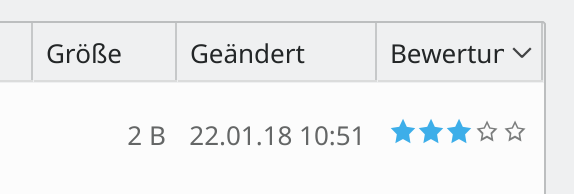
  • Dolphin’s Ratings UI now looks good in HiDPI mode (KDE Phabricator revision D10324, improved in KDE Applications 18.04):
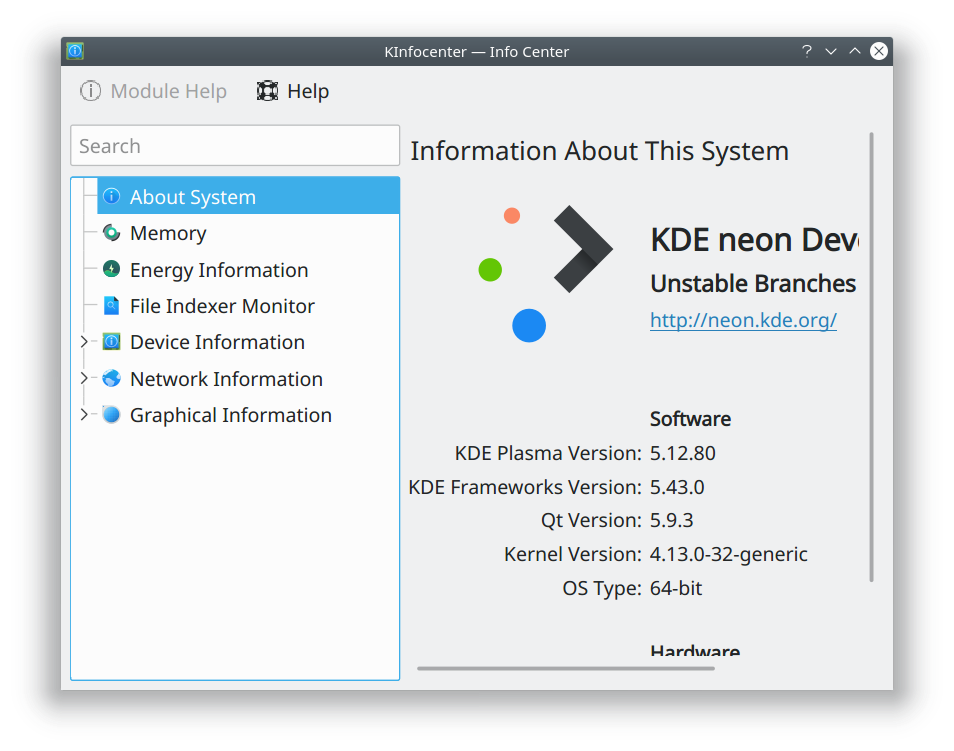
  • Fixed a visual glitch causing high-resolution or vector distro logos and the plasma logo in KInfoCenter to appear pixellated and glitchy in HiDPI mode; they are also now sharp and pretty (KDE bug 388633, fixed in KDE Plasma 5.12.1):
  • Fixed a bug causing Chromium and Chrome to always append “.bin” to the end of downloaded files for users of distros with old versions of Qt and/or the shared-mime-info package (KDE bug 382437, fixed in KDE Frameworks 5.44)
  • Network mounts from /etc/fstab, autoFS, or FUSE now show up under the “Network” category in the Places panel (KDE Phabricator Revision D10319, available in KDE Frameworks 5.43)
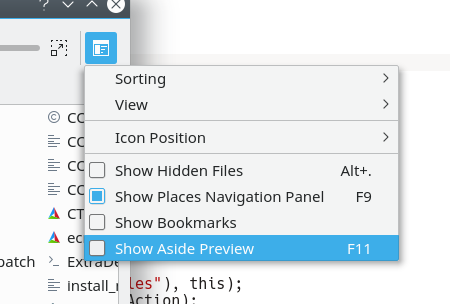
  • You can now use the F11 keyboard shortcut to toggle the aside preview pane in KDE open/save dialogs (KDE bug 389880, available in KDE Frameworks 5.43):
  • Alt+Enter keyboard shortcut now opens the Properties dialog for Folder View (i.e. Desktop icons) just like it does in Dolphin (KDE bug 389862, available in KDE Plasma 5.13)
  • Mouse wheel now scrolls the correct number of lines in Konsole when using the libinput driver (KDE bug 386762, fixes in KDE Applications 18.04)
  • The escape key now cancels out of the ctrl+tab tab switcher menu in Kate and KDevelop (KDE bug 389484, fixed in KDE Applications 18.04)
  • Spreadsheet files located on Google Drive accessed using Dolphin now open in the correct app (KDE bug 388598, fixed in kio-gdrive 1.2.2)
  • The Print Manager received an enormous amount of fixes and improvements (Available in KDE Applications 18.04)
  • Items in Kate’s Sessions applet are now sorted alphabetically (KDE Phabricator revision D10208, fixed in KDE Applications 18.04)
  • Gwenview now respects the window manager’s commands to enter and leave Full Screen mode (KDE Bug 195046, fixed in KDE Applications 18.04)
  • Dolphin’s git plugin (available in the dolphin-plugins package can now perform merge and log actions (KDE Phabricator revisions D10213 and D10267, available in KDE Applications 18.04)
  • Lots of UI polish for Discover, including making it and all other Kirigami apps look good in HiDPI mode (KDE bug 390076, fixed in KDE Frameworks 5.44)
  • Move and copy performance with large files has been dramatically improved (KDE bug 384561, improved in KDE Frameworks 5.43)
  • Even faster move and copy performance with many small files (KDE phabricator revisions D10085 and D10124, improved in KDE Frameworks 5.43 and KDE Applications 18.04)

KDE developers are really picking up momentum, and the improvements are coming very rapidly. It’s a fantastic time to get involved in something big!

This week in Discover, part 5

This week Discover gained a lot of little UI polish improvements, and Discover developers also fixed a major crash present in 5.12.

  • The main Featured page now shows more apps on distros like Ubuntu and KDE Neon that have lousy AppStream data (KDE bug 390016, fixed in KDE Plasma 5.12.1):
  • Notifications now stick around for longer, so they’re easier to read (KDE bug 388087, fixed in KDE Plasma 5.12.1)
  • Discover’s button that takes you to the page where you can write a review now has correct padding within its overlay (KDE bug 390030, fixed in Plasma 5.12.1)
  • Fixed a prominent crash in 5.12 when searching from the app page, deleting the search term, and searching again (KDE bug 390114, fixed in Plasma 5.12.1)
  • Discover’s review submission button is now labeled “Submit” (KDE bug 390031, fixed in Plasma 5.13)
  • Discover’s review submission button is now visible but disabled for apps that aren’t installed yet, not gone entirely (KDE bug 390053, fixed in Plasma 5.13)
  • Discover (and all other Kirigami apps that have High-DPI and vector imagery) now look crisp and sharp when run in HiDPI mode (KDE bug 390076, fixed in KDE Frameworks 5.44)

If you like what you see, consider becoming a KDE contributor and join the team! The speed of improvements is pretty directly proportional to the amount of help we have, so the more hands on deck, the better KDE software becomes!

App popularity in Discover

Currently, Discover sorts apps by popularity. In this case, popularity means “number of ratings”, and ratings come from user reviews. This is why GNOME Tweak Tool shows up first in Discover’s browse list: apparently it’s very popular among GNOME users, and they’ve written lots of reviews about it. We should all follow their lead and write some quality reviews about our favorite software; this helps the best apps bubble up to the top, and users love reading reviews from other users when determining whether or not to install an app.

Here’s how to write a review in Discover:

First, browse to an app page, and click on the “Show Reviews” text to open the Reviews pop-up:

Now Click on the “Review” button to write a review:

Now write your review, then click Accept:

Worth mentioning: the visual imperfections you might have noticed in the above screenshots are tracked by KDE bugs 390030, 390031, 390032, and 390035. We also have plans to make reviews more prominent (KDE Phabricator revision D10237) and allow sorting by criteria other than popularity (KDE bug 383518).

What to write in a review

Here are some examples of unhelpful reviews:

  • “1 star, it crashes on launch on Debian 3”
  • “1 star, doesn’t have this one specific feature I want”
  • “1 star, Electron apps are the worst! Rewrite it in Qt/GTK/Wx/ncurses you n00bs!”

These reviews don’t communicate much useful information, or will quickly become inapplicable. Useful reviews are about the app itself, not the conditions in which it’s run, or the toolkit of programming language it’s been created with, or any one particular annoying bug. They honestly describe the app and its features, usefulness, and impact in a way that will be relevant to uses in a month, a year or even later. Reviews like this are a blessing to users everywhere, and make it easier to find new apps.

So go out there and review your favorite apps!

The future of distros

Today KDE released Plasma 5.12 with Long Term Support–the culmination of more than a year of work. It’s really awesome, and we think you’ll love it!

But how do you get it!?

It all depends on your distro! Let’s look at Linux distros today.

What makes a distro a distro?

Today it’s mostly the choice of release model. “Stable release” distros like Ubuntu and Linux Mint lock everything to a specific version, only offering feature upgrades only when a new major version of the distro is released. “Rolling release” distros like Arch and openSUSE Tumbleweed give you everything as close to the developers’ schedules as possible.

Each model has drawbacks:

  • Stable release distros will often saddle users with ancient, years-old software. For example, users of Debian Stable might not get to experience KDE Plasma 5.12 for another 2 or 3 years–or even longer.
  • Rolling release distros expose users to the latest version of everything, turning them into QA. Underlying system libraries often change and break apps that use them. The breakage is usually fixed quickly, but users are exposed to it in the first place.

Certain distros additionally try to go beyond mere packaging and releasing, and actually try to ensure some QA and polish in the final product. Distros like Ubuntu, Linux Mint, Manjaro, and Elementary that follow this model quickly rocket up to the top of the popularity pyramid. Users are desperate for distros with better QA and polish!

But it’s exhausting; if you package all the software, you’re responsible for it too. It’s a huge job, even for distros that base themselves on others, as they find themselves having to patch on top of patches, and manage two release cycles (their own, and the parent distro’s). Turnover and burnout are common.

Flatpak and Snap to the rescue

Flatpack or Snap provide the solution: 3rd party packaging. Instead of the distros doing the packaging, it comes either straight from the developers, or from a 3rd-party intermediary like Flathub.

For distros, the benefits are enormous: liberated from the grunt work chores of packaging and patching software, distros will be free to step wholeheartedly into their natural roles as arbiters of the final user experience, concentrating on impactful tasks like integrating diverse components, managing hardware support, performing QA, polishing the final product, and delivering it to users in an easy-to access manner. Fixes and patches can be submitted upstream, instead of duplicated locally. This is KDE’s relationship to Qt, in fact. It works great.

Snap and Flatpak also improve things for users and developers:

  • Users get to choose whether they want each app to be stable, up-to-date, or cutting-edge according to their preferences, and they get a clear chain of responsibility when there’s a bug.
  • Developers get to package their apps only once to make them available to everyone, and get to determine for themselves their software’s presentation, branding, and release schedule–rather than hoping that packagers for 500 different Linux distros do it for them, and then having to deal with bug reports about versions of their software that are years old.

Ultimately, Flatpak or Snap liberate us from the tyranny of low-quality distros that make Linux software look bad because they don’t do QA, integration, or UX testing to make sure that the final product is of high quality. Many will rightly vanish because they’re not providing much value for users or generating enough developer interest to continue existing. Once this happens, developers and users will gather around the smaller number of remaining distros, increasing each of their levels of manpower and user bases.

So no, distros don’t go away. In fact, the distros that are worth keeping will be able to focus on tasks that offer more value to users than mere software packaging. Far from erasing diversity, this will empower real and meaningful diversity–where we have a handful of really good and strongly differentiated distros whose products embody different philosophies, instead of an overwhelming number of mediocre distros with often only minimal differences, none of which really work well once you dig deeply. We’ll all win, and all of these vastly superior distros will be far stronger contenders when compared to Windows, macOS, and ChromeOS.

How you can help

There are many ways for you to help enter this brave new world of actual QA and polished products.

Users: If your favorite app offers a Flatpak or Snap version, use it! Quite a lot do. If you find problems, file bugs! If you find an app listing in KDE Discover or GNOME Software that doesn’t look good, submit better information! If you find cases where duplicate apps appear when browsing, submit patches to fix it!

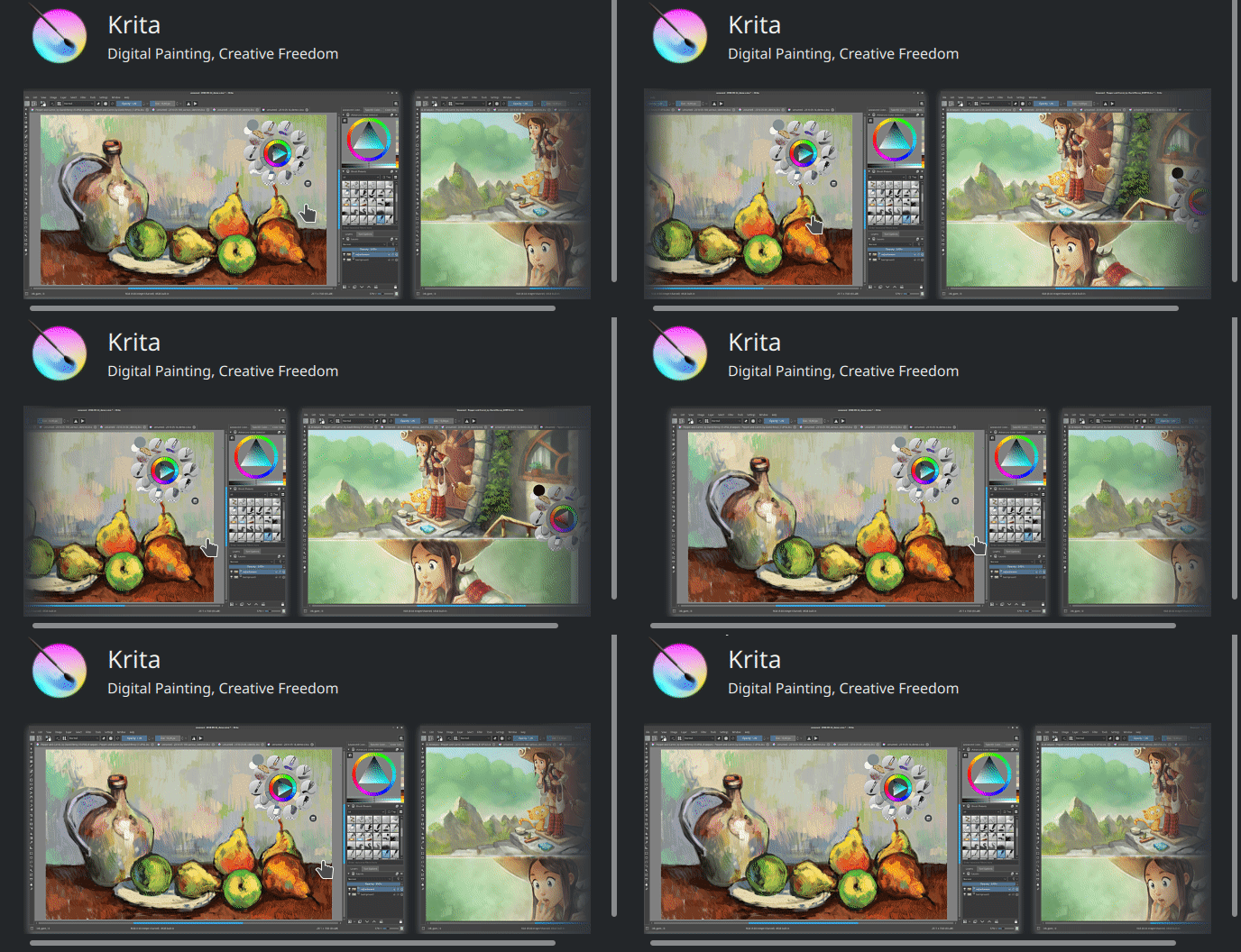
Software developers: Provide high-quality AppStream metadata and please submit your apps to Flathub! This goes for KDE developers, too. Krita and Kdenlive are already up, but I want to see Dolphin, Konsole, Kate, and all the rest!

Distro developers: don’t fight Flatpak or Snap; embrace them (and Flathub) and liberate yourself from packaging chores. Focus less on packaging software for your users, and more on performing the QA necessary to make sure that that software actually works well.

As always, consider becoming a KDE contributor if you like what you see! We can’t do this without you.

This week in Usability & Productivity, part 4

This was a big week for Usability & Productivity. Before I get to the list of improvements we landed, I’d like to make an exciting announcement: we’re scoping out the work to add FUSE support to KIO for remote locations like Samba shares. This should vastly improve the experience of interacting with files on Samba and FTP locations (among others) when using non-KDE software with KDE Plasma. No timelines or promises yet, but it’s now on our radar screens.

Anyway, let’s move onto the list of improvements this week. I think you’re going to like ’em!

  • The panel’s height is now shown in pixels when being changed, and can be minutely adjusted using the scroll wheel (KDE bug 372364)
  • Y axis labels for the network widget’s speed graph no longer overlap with the grid lines (KDE Phabricator revision D10183):
  • Spectacle’s Save button now remembers the most recently used save mode by default (KDE Phabricator revision D10153)
  • Spectacle’s Save button now defaults to showing “Save As” instead of “Save & Exit” (KDE bug 389614)
  • Spectacle now uses the correct icon for the “Export Image…” button, and now it also shows up properly when using the Breeze Dark theme (KDE bug 389775):
  • Dolphin no longer scrolls so quickly in icons mode when there are icons with really long/tall filenames (KDE Phabricator revision D10102)
  • A huge amount of work went into improving the speed of move and copy operations, especially for many small files (KDE bug 342056, KDE Phabricator revisions D10155, D10256, D10261, and D10282). More is still in the pipeline, too.
  • You can now put Dolphin’s Terminal pane on any part of the window, not just the top or bottom (KDE bug 362593):
  • Gwenview’s file rename dialog now excludes the filename extension from the initial selection (KDE Phabricator revision D9632)
  • When using Gwenview in Full Screen mode, showing the sidebar no longer moves part of the top toolbar (including the “exit Full Screen” button) out of view (KDE bug 387784)
  • Hitting the Escape key now exits Full Screen mode in Gwenview (KDE bug 305659)
  • When Gwenview is quit while in Full Screen mode, it no longer re-opens maximized (KDE Phabricator revision D10207)
  • Gwenview now lets you choose the ICC color rendering intent, rather than hardcoding “Perceptual” (KDE bug 359909):
  • Konsole gained the ability to blur the background when the window is transparent (KDE bugs 198175):
  • The standard KWin blur effect has been made blurrier by default (the blur strength is still user-configurable) to offer better out-of-the-box readability for things that use it, like the Application Dashboard (KDE phabricator revision D10180):
  • Text input in KRunner now always works on Wayland (KDE bug 385693)
  • The close button on Okular’s pop-up note annotation now uses the correct cursor (KDE bug 384381):
  • New Breeze icon for Emacs and better icon for Virtualbox (KDE Phabricator revision D10211 and KDE bug 384357):
  • Kate/KDevelop syntax highlighting now displays correctly for numeric literals with underscores in Python (KDE big 385422)
  • KSysGuard tabs now correctly show ampersand (&) characters (KDE bug 382512)
  • Many bug fixes for Discover

Yes folks, all of this happened in ONE WEEK! The volume of contributions is starting to accelerate, and we’re really firing on all cylinders these days. It’s the perfect time to get involved. You don’t need to be a programmer. We’ve got design tasks, bug triaging, promotion, the works! We’re aware that our wiki is a bit scattered and sparse, and we’re working on cleaning that up, too. Since it’s a wiki, please feel free to make improvements!

And there’s more coming, too. I wasn’t able to mention in this week’s status update quite a few exciting fixes that are still going through the review process.

This is an exciting time to be a KDE user or contributor. Feel the energy. Be part of something big. Cynicism and inactivity are easy, but ultimately not satisfying; this is the moment to rise above the pervasive malaise of our time. Climb aboard, and help us build something truly magnificent.

This week in Discover, part 4

In preparation for the impending release of Plasma 5.12, this was a big bug-squashing week in Discover thanks to lead Developer Aleix Pol, who knocked out a huge number of reliability and stability issues in Discover! We also got in a few UI polish and usability improvements, too.

  • The number of available updates is now always consistent (KDE bug 389108)
  • Update notifications are no longer shown twice in certain circumstances (KDE bug 389429)
  • Fixed a crash when opening Discover with the Flatpak backend installed, but without the system Flatpak libraries (KDE bug 380496)
  • Fixed a crash while searching (KDE bug 385679)
  • Fixed a regression where the screenshot overlay would lose keyboard focus (KDE bug 389510)
  • Fixed a memory leak when browsing the Plasma Addons category (KDE bug 387630)
  • Made the Reviews pop-up have less side padding for better readability and usability (KDE bug 389536)
  • The scrollbar on the settings page no longer overlaps interactive UI elements (KDE bug 389602)
  • Repo list items no longer expose redundant Filter buttons (KDE bug 389767)
  • Discover’s settings page displays repos in a much more usable and readable manner (KDE bugs 389714 and 389715):

 
“Xenial (Main)” being listed twice is a bug we’re working on; the second one is the source repository, but it doesn’t communicate that. Little by little!

It’s constant improvement like this that adds up over time to produce great software. We think you’re going to love Discover in Plasma 5.12, and we’re continuing to work on making it even better!

If you like what you see, please consider helping out! If we were pirates, we’d say, “yer money or yer time, yarr!”