
My colleague and friend David Edmundson was interviewed recently on Brodie Robertson’s “Tech Over Tea” channel, and I seriously encourage everyone to watch it! David has a blog (which you should also read) but is far too modest to post about the interview there, so I’m doing it here. 🙂 The interview is long, but worth it. Check it out!
Author: Nate
No TWiK this week
See you next week, folks!
This week in KDE: colorblindness correction filters
This week there’s a lot of news on the accessibility front in particular! Beyond that, we have a fairly juicy assortment of other new features and user interface improvements, so have a look:
Plasma 6
General info – Open issues: 103
KWin now includes an effect that can change the colors on the whole screen to better support people with various forms of color-blindness! (Fushan Wen, link):

The F10 key is now used in most KDE apps (with more being ported soon) to open the main menu or hamburger menu. This means that the keyboard shortcut to create a new file had to be changed to Ctrl+Shift+N, which also makes it more consistent with what’s used in other environments (Felix Ernst, link)
Kate, KWrite, and other KTextEditor-based apps gained support for speaking text from the document! (Christoph Cullmann, link)
Throughout QtQuick-based KDE software, scrolling using a mouse wheel now smoothly animates the view! Smooth scrolling, baby! Note that this is different from inertial scrolling for touchpads, which is not implemented yet. For more information, see this wiki page. (HeCheng Yu and Fushan Wen, link)
When your Panel has a Task Manager widget on it, the feature to add panel launchers (as opposed to pinned Task Manager apps) has been hidden to avoid confusing people. You can still add them manually if you want, but the way to do it is no longer so in-your-face. As a part of this, the Traditional Task Manager has been changed so that its pinned launchers no longer disappear by default when used to launch an app; they now stay where they are and can be used to open new instances, so they feel more like panel launchers now. This is configurable if you liked the old approach better, of course! (Niccolò Venerandi, link 1 and link 2)
LibreOffice documents now appear in Plasma’s “Recent Documents” list (Méven Car, link)
Cursor theme previews are no longer drawn too small when using scaling on Wayland, and are no longer pixelated when using a fractional scale factor (Fushan Wen, link 1 and link 2)
Locally-downloaded and manually installed packages installed using Discover can now be upgraded and uninstalled (Alessandro Astone, link)
Offline Updates in Discover now report their progress more accurately (Alessandro Astone, link)
In the Plasma Wayland session, it’s now possible to mirror (as in, visually flip) a display if needed (Xaver Hugl, link)
Other User Interface Improvements
The default location where Spectacle saves screenshots and screen recordings has been changed; now they are saved to ~/Pictures/Screenshots and ~/Videos/Screencasts, respectively. And of course these default settings can be changed if you’d prefer them to be saved elsewhere! (Noah Davis, Spectacle 24.02. Link)
Elisa’s color scheme chooser menu now looks native, not kinda weird (Jack Hill, Elisa 24.02. Link)
Other Significant Bugfixes
(This is a curated list of e.g. HI and VHI priority bugs, Wayland showstoppers, major regressions, etc.)
Fast user switching from a passwordless user account now works (Harald Sitter, Plasma 5.27.9. Link)
In Dolphin, the “Create New” menu now correctly enables and disables itself as needed when you switch tabs (Amol Godbole, Dolphin 24.02. Link)
Other bug-related information of interest:
- 4 Very high priority Plasma bugs (up from 3 last week). Current list of bugs
- 55 15-minute Plasma bugs (down from 56 last week). Current list of bugs
- 89 KDE bugs of all kinds fixed this week. Full list of bugs
Automation & Systematization
Added an autotest to make sure the Panel’s Edit Mode toolbox works (Fushan Wen, link)
Added some autotests to make sure the new Kirigami list delegates work properly; more on that soon! (Ivan Tkachenko, link)
…And Everything Else
This blog only covers the tip of the iceberg! If you’re hungry for more, check out https://planet.kde.org, where you can find more news from other KDE contributors.
How You Can Help
We’re hosting our Plasma 6 fundraiser right now and need your help! If you like the work we’re doing, spreading the wealth is a great way to share the love. 🙂
If you’re a developer, work on Qt6/KF6/Plasma 6 issues! Plasma 6 is usable for daily driving now, but still in need of bug-fixing and polishing to get it into a releasable state by February.
Otherwise, visit https://community.kde.org/Get_Involved to discover other ways to be part of a project that really matters. Each contributor makes a huge difference in KDE; you are not a number or a cog in a machine! You don’t have to already be a programmer, either. I wasn’t when I got started. Try it, you’ll like it! We don’t bite!
This week in KDE: re-organized System Settings
Plasma 6
General info – Open issues: 91
System Settings’ sidebar has gotten a much-needed re-organization! This is still under development and may change a bit before the final release, so don’t consider the following screenshots 100% final. Probably 90% final. But anyway, but here’s what we’ve got right now (me: Nate Graham, link):


Changed who handles screen arrangements in the Plasma Wayland session: until now, it was KScreen, whereas now for Plasma 6, KWin has absorbed that functionality. This will make it much easier to ensure a good UX here because state will be centralized in one location, rather than having it be synchronized across two components that need to be in communication with one another. This proved fragile throughout Plasma 5. The work has already fixed three bugs, with more to come. Ultimately this means that KScreen is now feature-frozen, and no further changes to multi-screen handling on X11 should be expected in Plasma 6 (Xaver Hugl, link)
While Discover is fetching updates, its progress bar now corresponds much closer to actual reality, instead of being more like a random number generator (Alessandro Astone, link 1 and link 2)
Discover now lets distros opt into turning on dependency auto-remove for apps that are removed with Discover (Alessandro Astone, link)
When the screen resolution or scale changes–which can happen when additional screens are plugged in–the wallpaper now instantly resizes to the new desktop geometry rather than doing an animated fade, which in this context just looked weird and glitchy and broken (Marco Martin, link 1 and link 2)
Improved the Breeze Night Color icon (Philip Murray, link):

Other New Features
Spectacle’s screen recording feature gained support for recording using the VP9 codec (CPU rendering only for now, but GPU acceleration is coming soon). In the process, the default location where screen recordings get saved to has been made customizable (Noah Davis, link 1, link 2, and link 3)
Other Significant Bugfixes
(This is a curated list of e.g. HI and VHI priority bugs, Wayland showstoppers, major regressions, etc.)
Fixed a bug in Discover that could cause it to crash for some people after searching, or even when just launching the app (Harald Sitter, link 1 and link 2)
In the Plasma X11 session, various QtQuick-based dialog windows will no longer be missing their close buttons (Vlad Zahorodnii, Plasma 5.27.9. Link)
Apps and Plasma can no longer crash when told to use DBus to launch an app with a malformed .desktop file name that’s out of compliance with the spec (David Redondo, Frameworks 5.111. Link)
Other bug-related information of interest:
- 3 Very high priority Plasma bugs (down from 4 last week). Current list of bugs
- 56 15-minute Plasma bugs (down from 58 last week). Current list of bugs
- 91 KDE bugs of all kinds fixed this week. Full list of bugs
Automation & Systematization
Added more GUI tests for the Battery & Brightness widget, the Clipboard widget’s barcode page, and the System Settings Users page’s avatar chooser sheet (Fushan Wen, link 1, link 2, and link 3)
…And Everything Else
This blog only covers the tip of the iceberg! If you’re hungry for more, check out https://planet.kde.org, where you can find more news from other KDE contributors.
How You Can Help
We’re hosting our Plasma 6 fundraiser right now and need your help! If you like the work we’re doing, spreading the wealth is a great way to share the love. 🙂
If you’re a developer, work on Qt6/KF6/Plasma 6 issues! Plasma 6 is usable for daily driving now, but still in need of bug-fixing and polishing to get it into a releasable state by February.
Otherwise, visit https://community.kde.org/Get_Involved to discover other ways to be part of a project that really matters. Each contributor makes a huge difference in KDE; you are not a number or a cog in a machine! You don’t have to already be a programmer, either. I wasn’t when I got started. Try it, you’ll like it! We don’t bite!
This week in KDE: time for the new features
The floodgates opened this week, and a lot of consequential in-progress work was merged: juicy new Plasma 6 features, long-awaited bugfixes, spicy automated testing, and more!!!
Plasma 6
General info – Open issues: 94
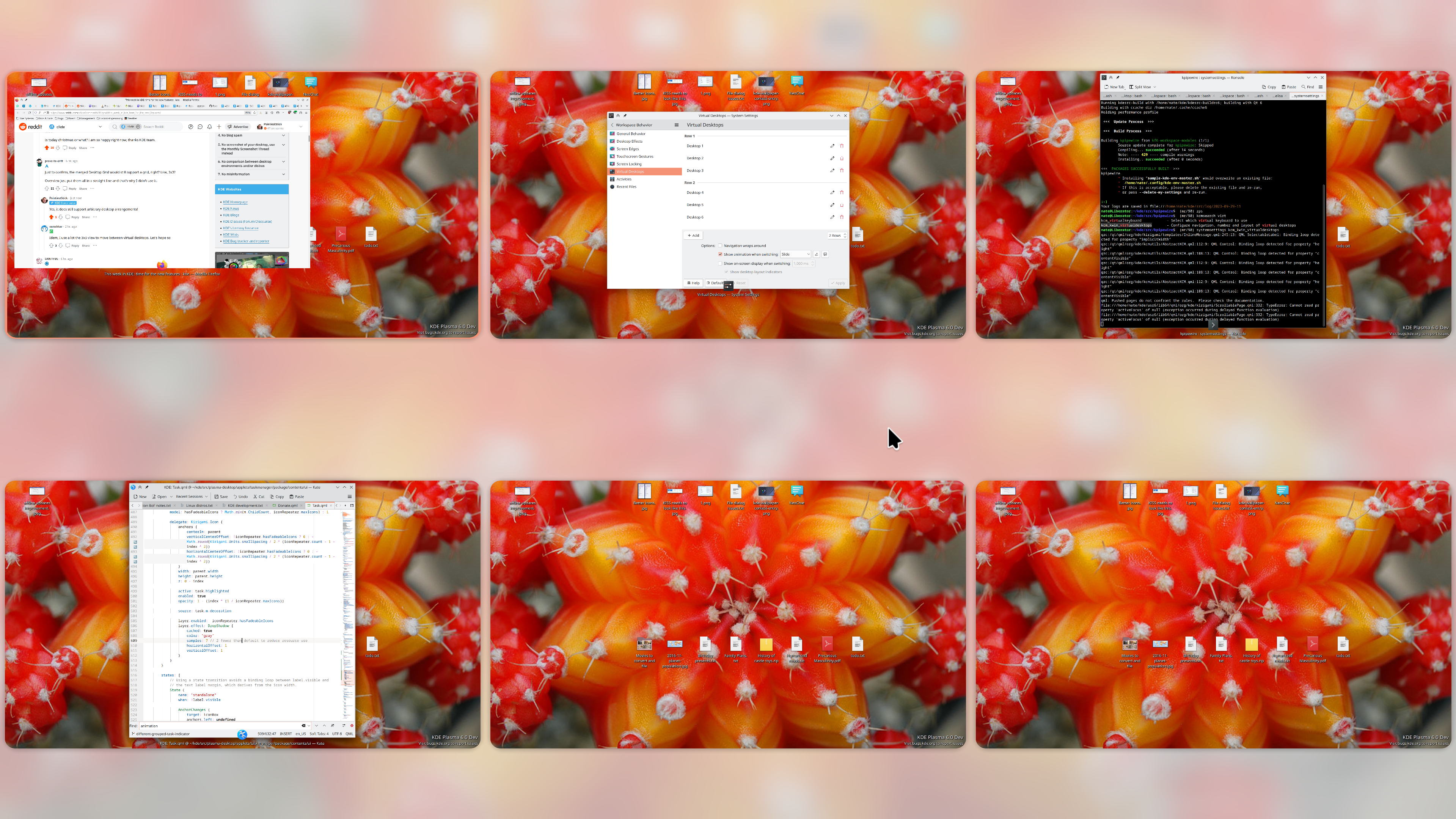
The Overview and Desktop Grid effects have been merged together into one, with fluid and natural-feeling touchpad gestures to transition between all states. It’s really awesome work, and also fixed a ton of open bug reports! (Niccolò Venerandi, link):

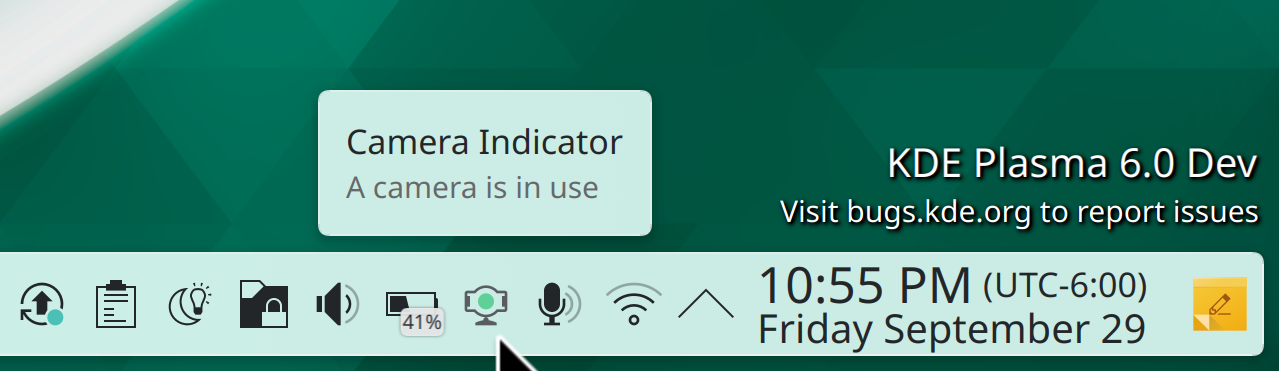
In the Plasma Wayland session, there’s now a System Tray monitor that shows you when something is using the camera, just like we already have for screen recording and microphone usage (Fushan Wen, link 1 and link 2):
Floating panels now have nice shadows, and when they de-float, they no longer have ugly chunky margins! Additionally, when the panel is floating, any popups opened from it are floating too, with nice rounded corners on all sides. Oh, and with this blocking work done, we’ve made floating panels on by default! (Niccolò Venerandi, link 1, link 2, link 3, and link 4):
There’s now a new global shortcut (Meta+Alt+L by default) to switch between the current and last-used keyboard layout, which can be useful for people who have more than two layouts but commonly switch between two of them on a regular basis (Mihail Milev, link 1 and link 2)
Icons drawn by Kirigami.Icon–which in Plasma 6 is nearly all of them in KDE’s QML software–now look better and sharper when using a fractional scale factor (Marco Martin, link)
Fixed multiple focus issues in System Settings: it’s now possible to focus the sidebar again after focusing the main page, and also pressing the down arrow key in System Settings’ search field now moves focus to the list view, which is especially helpful after searching for something (Fushan Wen, link 1 and link 2)
Started improving the presentation of the permissions of Flatpak apps in Discover, including using better icons, more user-friendly text, and showing the “sound system access” permission, which we had previously been ignoring (me: Nate Graham, link 1, link 2, and link 3)
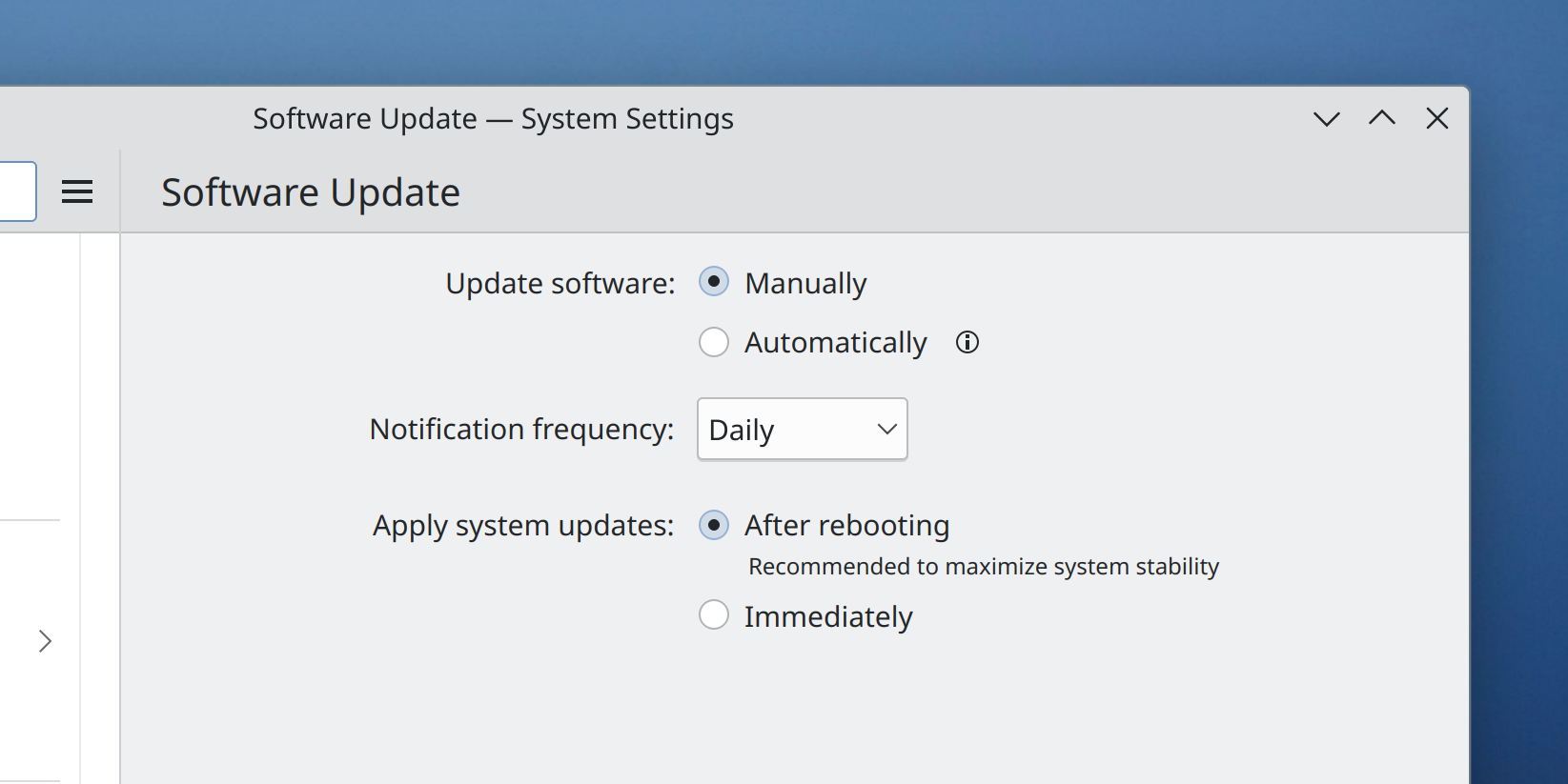
The setting to toggle “offline updates” no longer uses that confusing terminology anymore (me: Nate Graham, link):
The “About” pages in System Monitor and Filelight were both ported to the new Form Card style (Carl Schwan, link 1 and link 2)
For a cleaner and less confusing presentation, common shortcut-choosing views now hide the local-only columns when all shortcuts are global, just like we already hide the global-only columns when all shortcuts are local (me: Nate Graham, link)
Made some fixes to monitor handling that should decrease the likelihood of the monitor instantly waking up right after being put to sleep (Xaver Hugl, Plasma 6.0. Link)
When using the Plasma systemd integration (which is on by default when you have systemd), Plasma is now more comprehensive about killing processes when logging out, which should prevent crashes at logout and dangling zombie processes that can prevent logging in again. This might end up being backported, too! (David Edmundson, link)
When using a Panel on the bottom screen edge, Task Manager tooltips that include media controls are no longer sometimes positioned in the wrong place (David Edmundson, link)
Breeze-themed GTK2 apps no longer look wrong (well, not as wrong, at least) when using a dark theme (Someone going by the pseudonym “Mors Mortium”, link)
It’s now possible to remove a favorite from Kickoff and other launcher menus whose underlying app or file has since been deleted (Méven Car, link)
Page headers throughout Kirigami-based software will no longer sometimes elide titles when there’s plenty of room for them when using certain combinations of fonts and font sizes (Ivan Tkachenko, link)
Other Significant Bugfixes
(This is a curated list of e.g. HI and VHI priority bugs, Wayland showstoppers, major regressions, etc.)
It’s no longer possible for the lock screen to break and show the dreaded “the screen locker is broken” screen due to QML cache corruption as a result of running out of space on the system. To be clear, it can still break for other reasons too, but we are working on tracking those down as well! (Harald Sitter, Plasma 5.27.9. Link)
Fixed the actual root cause in KDE software for the “ever-growing ScreenMapping config file key causes Plasma to crash or fail to launch new apps” issue. And that fix also allowed us revert the stopgap fix to cap the number of mappings and fix icons being always unsorted when there was a huge amount of stuff on the desktop (Marco Martin, Plasma 5.27.9. Link)
Fixed multiple issues with Discover’s reviews popup, including being too slow and sometimes failing to load or submit reviews (Marco Martin, Plasma 5.27.9. Link 1, link 2, and link 3)
KMenuEdit once again correctly creates .desktop files with exec= keys that point to executable files that have spaces or other special characters in their file paths (Méven Car, Plasma 5.27.9. Link)
In KRunner and KRunner-powered searches, searching for recent files is once again correctly completely case-insensitive as expected (Alexander Lohnau, Plasma 5.27.9. Link)
Fixed a fairly complex issue that was causing Flatpak-based GNOME apps to display text without any anti-aliasing when run in Plasma (Timothée Ravier, Plasma 5.27.9. Link )
If a touchscreen calibration matrix has been configured, KWin now respects it (someone doing by the pseudonym “The Official GMan”, Plasma 5.27.9. Link)
It’s now possible to use the keyboard to focus buttons in the toolbars of KDE apps using the KXMLGui framework (Felix Ernst, Frameworks 5.111. Link)
Other bug-related information of interest:
- 4 Very high priority Plasma bugs (same as last week). Current list of bugs
- 58 15-minute Plasma bugs (down from 59 last week). Current list of bugs
- 127 KDE bugs of all kinds fixed this week. Full list of bugs
Automation & Systematization
Added basic UI tests for the applets and System Settings pages that live in plasma-workspace! (Fushan Wen, link 1 and link 2)
Fixed various problematic autotests in the Kirigami and KSvg frameworks, and made it mandatory for them to pass before merge requests can be merged (Marco Martin, link 1 and link 2)
…And everything else
This blog only covers the tip of the iceberg! If you’re hungry for more, check out https://planet.kde.org, where you can find more news from other KDE contributors.
How You Can Help
If you’re a developer, work on Qt6/KF6/Plasma 6 issues! Plasma 6 is usable for daily driving now, but still in need of bugfixing and polishing to get it into a releaseable state by the end of the year.
Otherwise, visit https://community.kde.org/Get_Involved to discover other ways to be part of a project that really matters. Each contributor makes a huge difference in KDE; you are not a number or a cog in a machine! You don’t have to already be a programmer, either. I wasn’t when I got started. Try it, you’ll like it! We don’t bite!
And finally, KDE can’t work without financial support, so consider making a donation today! This stuff ain’t cheap and KDE e.V. has ambitious hiring goals. We can’t meet them without your generous donations!
A bit on sponsorship and money
The topic of sponsored work comes up surprisingly often. Now, many KDE developers are already sponsored by businesses to work on KDE software, either on a full-time-work basis, or for specific areas of work. But what’s less common is for a specific person to sponsor another specific person to work on a specific bug or feature. I’m talking about short-term gigs paying most likely a few hundred euros or less. This can work well for getting persistent bugs in the yellow boxes fixed. It does happen, but it’s not as common as I think anyone would like! There’s a lot of untapped potential here, I think.
So today I’d like to announce the creation of a “Sponsored work” category in the KDE forum! This is a place for people to come together for the purpose of sponsoring work on individual bugs or features. If you’re willing to sponsor work for something, post about it here. If you’re open to these kinds of micro-sponsorship opportunities, look for them here!
Since we are a free software community, sometimes concerns about money and sponsored work arise. Therefore, let me bring up an additional option, originally thought up by Jakob Petsovits the last time someone offered to sponsor work: offer an option to donate the sponsorship money to KDE e.V.! This option can be more motivating for passionate KDE developers who don’t personally need the money, and might otherwise ignore such opportunities.
On the subject of donating to KDE e.V., we have a fancy new donation web page that makes it much easier to set up recurring donations! This being too hidden was been a very valid complaint in the recent past, so it’s wonderful to see a better UX here. This work was done by Carl Schwan, Paul Brown, and others at this weekend’s Promo Sprint–which is itself funded by KDE e.V.
And at this point, KDE e.V. is funding quite a lot of initiatives. Sprints have come roaring back, and we’re sponsoring people to represent KDE at more external events than ever before. We also have a whole bunch of employees and contractors doing meaningful technical work on core KDE software. It’s a lot!
Needless to say, this isn’t cheap. KDE e.V. has been funding this major expansion by deliberately spending down its reserves for a few years to avoid getting in trouble with the German tax authorities for having too much money (yes, really; this is actually a thing). But that can’t last forever! We’re going to need help to sustain this level of financial activity.
If you can, consider setting up a recurring donation today! It really does make a difference. Anything helps!
This week in KDE: an unfrozen panel for NVIDIA Wayland users
Though the number of total Plasma 6 known issues rose this week, we managed to fix some major and longstanding ones from Plasma 5! You might recognize a few in the text below. Ultimately, these were deemed more pressing than the comparatively minor new ones. We’ll be continuing to hammer those bugs, but we do need help–your help! Discovering bugs is important, but so is fixing them, and we need help to get it done.
Plasma 6
General info – Open issues: 90
Fixed the infamous issue of Panels visually freezing in the Plasma Wayland session when using a non-Intel GPU in conjunction with the Basic QtQuick render loop and Task Manager previews turned on (David Edmundson et al, link)
Searching for apps, System Settings pages, and other things classified internally as “services” in KRunner and other KRunner-powered search tools (such as Kickoff) now matches English text as well when using the system in a language that’s not English (Alexander Lohnau, link)
When using a single-row Icons-Only Task Manager, the last opened task on the row is no longer sometimes missing under certain circumstances (Marco Martin, Link)
Fixed a bug that could cause auto-started apps with System Tray icons to sometimes not show their System Tray icons as expected until manually quit and re-launched (David Edmundson, link)
Fixed various cursor glitches and brokenness when using rotated screens in the Plasma Wayland session on a GPU that supports hardware cursors (Xaver Hugl, link)
The “Manually block sleep and screen locking” switches of multiple Battery and Brightness widgets are now synchronized; when one is toggled, all of them will change as well (Natalie Clarius, link)
Repeated messages on the lock screen now do a little bounce, rather than piling up and repeating themselves (me: Nate Graham, link):
Reduced resource usage in QtQuick apps that have mnemonics–those little underlines below letters when you hold down the Alt key (Kai Uwe Broulik, link 1 and link 2)
The menu item that says “Enter Edit Mode” now changes to “Exit Edit Mode” when you’re already in Edit Mode (me: Nate Graham, link)
The Kirigami.BasicListItem component has been deprecated with a planned removal in KF6, because it was too slow, heavy, and inflexible, worsening performance in QtQuick apps that used a lot of them. In its place are a new set of lightweight components that are thin wrappers around the standard Qt ItemDelegate, CheckDelegate etc. components, plus some more basic building blocks for making custom list items. This provides most of the convenience of BasicListItem, without the performance overhead (Arjen Hiemstra, link)
Other Significant Bugfixes
(This is a curated list of e.g. HI and VHI priority bugs, Wayland showstoppers, major regressions, etc.)
Gwenview now displays images more correctly when using a fractional scale factor in the Plasma Wayland session (Kai Uwe Broulik, Gwenview 24.02. link)
Fixed multiple bugs in Elisa that could cause odd and incorrect behavior when you re-arrange the contents of the playlist around the currently-playing song (Jack Hill, Elisa 24.02. Link)
Filelight once again respects the settings regarding folders exclusions and filesystem boundaries (Yifan Zhu, Filelight 23.08.2. Link)
When closing a document in Kate and KWrite that has unsaved changes, you’ll no longer see two dialogs asking you if you want to save them (Kai Uwe Broulik, Kate and KWrite 23.08.2. Link)
Widgets using the standard Plasma Calendar integration will no longer sometimes display holidays from the default region, rather than the selected one (Eugene Popov, Plasma 5.27.9. Link)
Other bug-related information of interest:
- 4 Very high priority Plasma bugs (down from 5 last week). Current list of bugs
- 59 15-minute Plasma bugs (same as last week). Current list of bugs
- 121 KDE bugs of all kinds fixed this week. Full list of bugs
Automation & Systematization
Added some autotests for MPRIS media playback global shortcuts (Fushan Wen, link 1 and link 2)
…And everything else
This blog only covers the tip of the iceberg! If you’re hungry for more, check out https://planet.kde.org, where you can find more news from other KDE contributors.
How You Can Help
If you’re a developer, work on Qt6/KF6/Plasma 6 issues! Plasma 6 is usable for daily driving now, but still in need of bugfixing and polishing to get it into a releasable state by the end of the year.
Otherwise, visit https://community.kde.org/Get_Involved to discover other ways to be part of a project that really matters. Each contributor makes a huge difference in KDE; you are not a number or a cog in a machine! You don’t have to already be a programmer, either. I wasn’t when I got started. Try it, you’ll like it! We don’t bite!
And finally, KDE can’t work without financial support, so consider making a donation today! This stuff ain’t cheap and KDE e.V. has ambitious hiring goals. We can’t meet them without your generous donations!
So let’s talk about this Wayland thing
Wayland. It comes up a lot: “Bug X fixed in the Plasma Wayland session.” “The Plasma Wayland session has now gained support for feature Y.” And it’s in the news quite a bit lately with the announcement that Fedora KDE is proposing to drop the Plasma X11 session for version 40 and only ship the Plasma Wayland session. I’ve read a lot of nervousness and fear about it lately.
So today, let’s talk about it!
What is Wayland?
Wayland is a set of protocols that govern how a compositor draws stuff on the screen, and how apps interact with the compositor’s drawing-stuff-on-the-screen infrastructure. It’s similar to the HTTP and SMTP protocols that govern how web browsers and email clients send and receive web pages and data.
Wayland also includes an implementation of those protocols in a set of extremely lightweight libraries called libwayland-client and libwayland-server that offer stable and versioned APIs. Apps and compositors such as KDE’s KWin and GNOME’s Mutter use those APIs to do stuff.
Why does Wayland exist?
In a nutshell, because X11–the thing it’s replacing–is dead.
X11 has been in maintenance mode for years, and recently has gotten no real development at all other than changes to the XWayland compatibility system that allows X11 apps to use a Wayland compositor. Having something as central as the window server being unmaintained is a major issue, as it means no bug fixes, no security patches, and no new features to let it keep up with a changing world.
Why did X die?
The fundamental X11 development model was to have a heavyweight window server–called Xorg–which would handle everything, and everyone would use it. Well, in theory there could be others, and at various points in time there were, but in practice writing a new one that isn’t a fork of an old one is nearly impossible. Everyone strongly preferred to standardize on a single X server and migrated in unison from one to another when a better fork became available, because it was convenient. And it was convenient because because it centralized limited development resources, and when a feature was added to the X server, everyone gained access to it automatically.
But there was a drawback: because everyone was using Xorg, any feature added to support any use case could break everything else that everyone else used, and this happened frequently. Bug fixes frequently regressed obscure functionality that others were using.
In essence, Xorg became too large, too complicated, and too fragile to touch without risking breaking the entire Linux ecosystem. It’s stable today because it’s been essentially frozen for years. But that stability has come hand-in-hand with stagnation. As we all know in the tech world, projects that can’t adapt die. Projects that depend on them then die as well.
How is Wayland any better?
Wayland was conceived of by X developers who wanted to avoid repeating their own mistakes. In addition to a lot of technical differences, by being a minimal set of protocols and two extremely thin client and server libraries, all the heavy lifting was delegated to individual compositors, which became the window servers of their environments. A new feature added to one would not destabilize any other compositors. Compositors were also free to implement new features via private protocols outside of the standard ones that apps only targeting that compositor could use.
Wait, that sounds like it sucks
Wayland has not been without its problems, it’s true. Because it was invented by shell-shocked X developers, in my opinion it went too far in the other direction. Wayland’s minimal core protocols are lacking most of the features that non-trivial apps and desktops actually need to work–such as screen locking, screen sharing, cross-app window activation, non-integer scaling, and so on. Compositors all needed to come up with ways to do these things themselves. And that need for each compositor to implement everything itself fragments development efforts and disadvantages small teams without the expertise of heavy-hitting graphics developers. These are real problems and we shouldn’t sweep them under the rug.
Yes, but there are solutions
Over time the minimal core protocols have been extended to cover what’s needed for a Linux desktop and sophisticated apps to work. Much of this work is very recent, driven by KDE, and funded by Blue Systems and Valve Software. So most complaints you read about Wayland missing this or that (such as fractional scaling, or screen sharing, or global shortcuts) from over a year or two ago are likely to be wrong today.
In addition, the problem of fragmentation of effort is being solved by wlroots, a library of Wayland implementations that you can use to build a Wayland compositor. We don’t use it in KDE’s KWin compositor because we already did most of that work ourselves before wlroots existed, but it’s a big benefit to anyone writing a new compositor from scratch today.
Another thing to consider is that this fragmentation brings some benefits: Wayland protocols having multiple distinct implementations in different compositors ensures that they remain properly compositor-agnostic, and not just publicly-facing implementation details of one compositor (like how Google treats the web these days).
Why is the adoption taking so long?
The fact that Wayland’s minimal core protocol made it unable to fully replace the thing it aimed to replace was a bad architectural design decision on the part of its authors that crippled the prospect of its rapid adoption when it was released in 2008. We didn’t see the same problem with other newer projects like Systemd and PipeWire which were adopted much faster.
And unfortunately, shepherding new protocols through the approval process to fix this problem is a grueling political exercise. It demands empathy and compromise with people from other projects who approach the problem you’re trying to solve from a fundamentally different perspective. Someone may disagree that the problem is even worth solving. Bikeshedding derails the discussion and everyone gets demoralized and stops working on it. For a long time, the urgency of pushing through it was low because X wasn’t dead yet.
So it took over a 15 years and resulted in Wayland’s dirty laundry being aired in public for that whole time. And that sucks. But… we’re there now. Standard protocols now exist for just about everything anyone needs. The few remaining obvious omissions (like screen color calibration) are being actively worked on as a matter of priority.
“Are we there yet?”
Plasma and KDE apps work great on Wayland, especially in the upcoming Plasma 6 release. Like I said, there are still a few omissions, but those holes are being plugged very quickly these days.
Most 3rd-party apps that aren’t Wayland-native also work fine via the XWayland compatibility layer. But there are some that don’t, because they integrate very deeply into some part of the system in a way that requires X11 support. These need to be ported to use new Wayland APIs.
A lot of app developers became accustomed to tuning out Wayland news while it was still a toy, and didn’t do the porting work. Well, it’s not a toy anymore, and now many are now feeling blindsided by the sudden urgency to port their apps to use Wayland. That’s understandable. But this time it’s for real, and the time to port is now. For any protocols that still aren’t good enough and need revision, app developers’ input is needed to revise them or even propose new ones. This process takes a long time, so better to start sooner rather than later. But it’s not just gonna go away.
Which brings us to Fedora KDE
Fedora has always been a “leading edge” distro that pushes forward the technical state of the art on Linux by adopting new technology once it’s mostly ready, thus causing it rapidly improve in a way that it otherwise would not have. Fedora was the first distro to adopt Systemd, PulseAudio, and PipeWire. It was the first to use the Plasma Wayland session by default. And now Fedora KDE wants to be the first to drop the Plasma X11 session entirely and make everyone use the Plasma Wayland session.
It should be clear that Fedora’s target audience consists of people who are excited about change. If this is you, all of these projects should seem exciting and cool! If not… then Fedora isn’t for you. And that’s fine. The Linux world has approximately five hundred bajillion distros. What’s that you say? Only about 20 of them are any good? Well, fair enough, but even if that pulled-out-of-someone’s-butt number is accurate, there are still 19 distros that aren’t Fedora! Reinstalling your OS is unpleasant, but it’s important to choose the right one that suits your needs and preferences. Choice comes with the responsibility of choosing wisely.
Maybe you’re afraid that Fedora is a “canary in the coalmine” that shows the way everything is going to go. And you wouldn’t be wrong about that, but transitions still take time. Distros that intentionally ship old software like Ubuntu LTS or Debian Stable will let you keep using X11 for years and years. Arch will probably keep shipping X11 for a while too. You have options. By the time Ubuntu LTS removes X11 too, everything will be fully ready.
Putting it all together
Wayland is a replacement for X11, which is dead. Despite a rocky development process, it’s ready enough for Plasma and KDE apps that Fedora KDE is pushing it pretty hard. Many 3rd-party apps are already Wayland-native, but many are not, and they need to put in the work to port to Wayland. If anything they need is still missing, they need to step up to be part of the process of adding it. This process is happening, and isn’t going to stop happening. We need to work together to make it happen faster and more smoothly.
This week in KDE: more Plasma 6 dev
This week it was pretty much all Plasma 6 all the time. With the release date four and a half months away, work is kicking into high gear to make sure that we hit our deadline!
Plasma 6
General info – Open issues: 87
Made even more cursor responsiveness improvements for the Plasma Wayland session! The cursor is really very responsive now 🙂 (Xaver Hugl, link)
This work as also substantially improved latency in general, especially for games (Xaver Hugl, link)
Kickoff now has an option to move its sidebar over to the other side of the main view. This has better Fitts’ Law adherence and zero risk of accidental category switching if you use the mouse pointer to activate Kickoff and launch Favorites more often than you activate it with the Meta key or switch categories (Forest Ix, link)
The default keyboard shortcut used to open the Activity Switcher has been changed to Meta+A, so that its prior shortcut Meta+Tab can be used some something else, which is coming soon… (Niccolò Venerandi, link)
When you have Powerdevil configured to hibernate after a period of sleep, invoking sleep using KRunner now respects that preference and hibernates at the appropriate time (Natalie Clarius, link)
Sped up the launch time of Plasma and QtQuick-based KDE apps by loading the mobile text editing toolbar on demand, rather than always (Fushan Wen, link 1 and link 2)
fstab-mounted NFS drives no longer produce duplicate items in the Places panel of various KDE apps and the open/save dialog (Méven Car, link)
Discover now shows release data for SteamOS system updates in a prettier and more comprehensible way (Jeremy Whiting, link)
Discover’s “About” page now uses the newer and more attractive FormCard style (Carl Schwan, link):

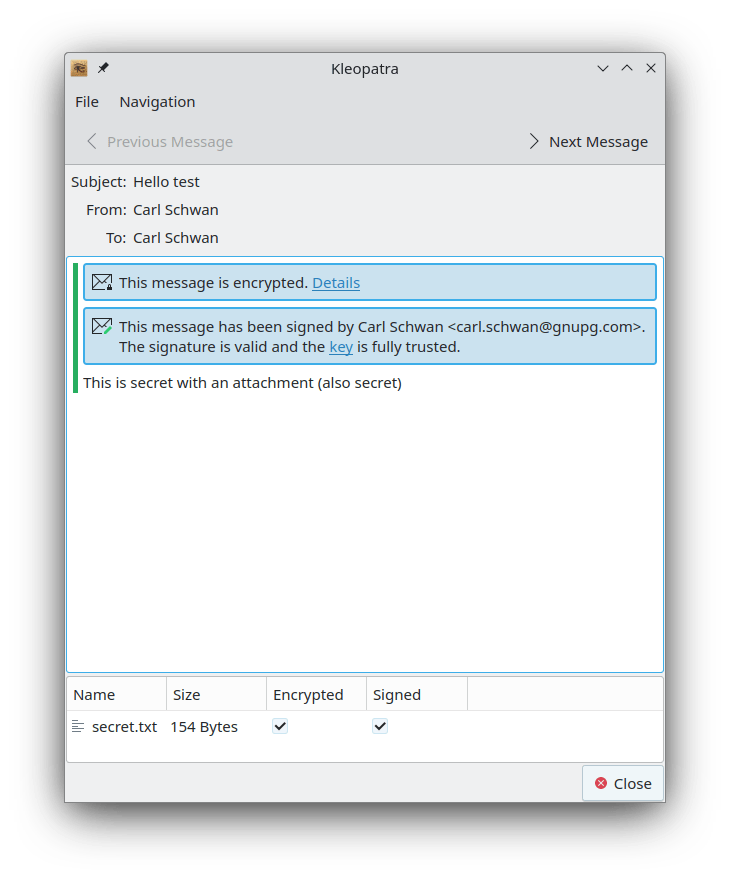
A variety of QtWidgets-based dialog windows that have menubars or toolbars now use the common unified header style that KDE’s app windows use (Carl Schwan, link):
Created a new standard component: Kirigami.InlineViewHeader, and ported a bunch of list and grid views to use it (me: Nate Graham, link):
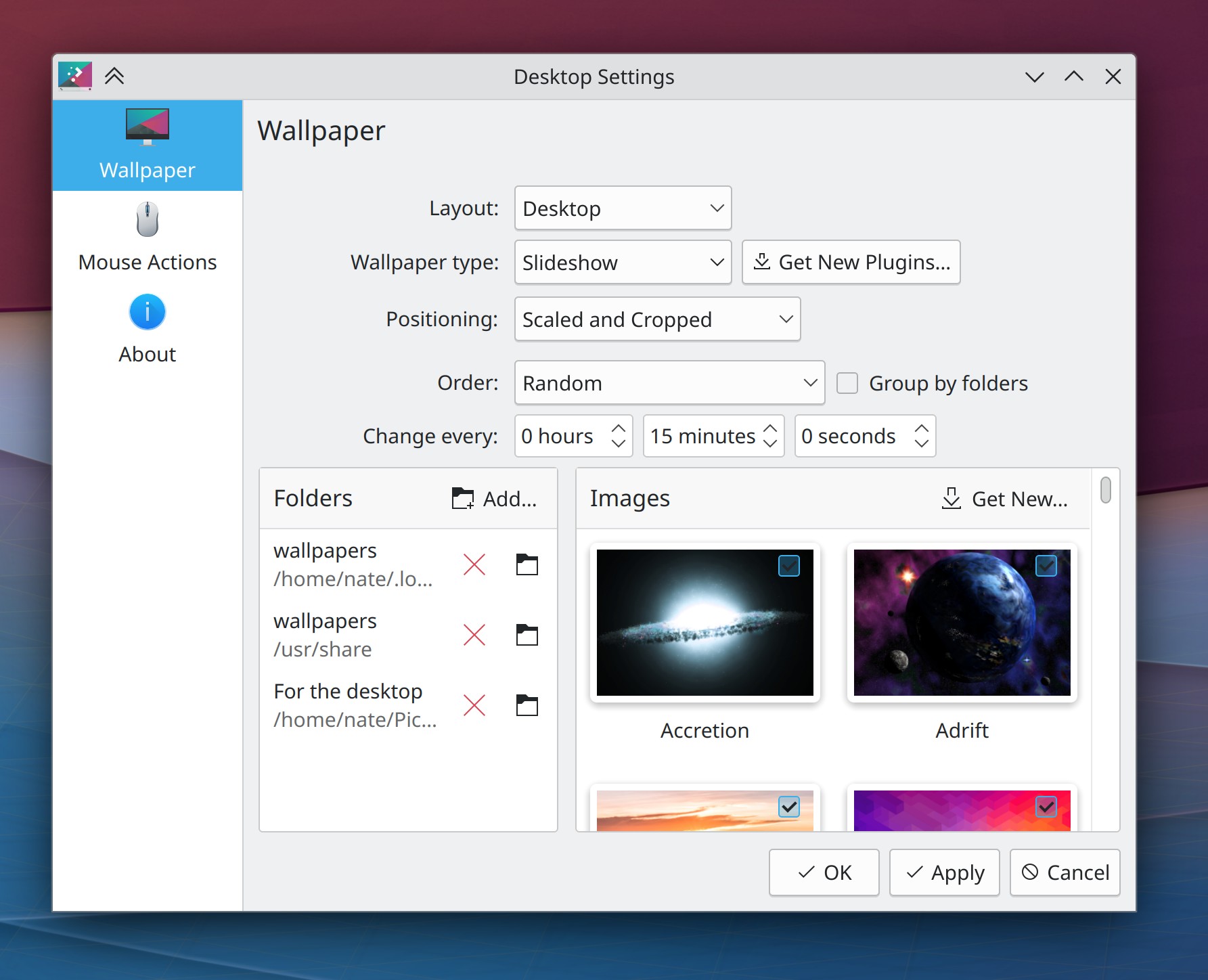
The “Upgrade your distro now” notification message is no longer radioactive (Oliver Beard, link)
Other Significant Bugfixes
(This is a curated list of e.g. HI and VHI priority bugs, Wayland showstoppers, major regressions, etc.)
Spectacle now takes Rectangular Region screenshots correctly when you’re using any screen scale factors less than 100% (Noah Davis, Spectacle 24.02.0. Link 1 and link 2)
Fixed a case where the touchpad daemon could randomly crash (Gabriel Souza Franco and Fushan Wen, Plasma 5.27.8. Link)
Fixed a rare case where KWin would crash in the Plasma Wayland session when waking from sleep (Xaver Hugl, Plasma 5.27.9. Link)
The Alt+Tab window switcher is now fully accessible via the standard Orca screen reader in the Plasma Wayland session (Fushan Wen, Plasma 5.27.9. Link)
While updating a lot of Flatpak apps at the same time, discover can no longer exhaust the system’s set of available file handles and then fail (Discover 5.27.9. Link)
Automatically turning off the keyboard backlight when on battery power now works, if you’ve configured it to do this (Nicolas Fella, Plasma 6.0. Link)
Fixed a bug that could cause KIO-using apps to crash when trying to overwrite a file under certain circumstances (Kevin Ottens, Frameworks 5.111. Link)
Other bug-related information of interest:
- 5 Very high priority Plasma bugs (up from 4 last week). Current list of bugs
- 59 15-minute Plasma bugs (up from 58 last week). Current list of bugs
- 119 KDE bugs of all kinds fixed this week. Full list of bugs
Automation & Systematization
Added autotests for KHamburgerMenu (Felix Ernst, link)
Added more autotests for window placement in KWin (Vlad Zahorodnii, link)
Fixed a flaky autotest for the Task Manager in Plasma, and also expanded it to cover more things (Fushan Wen, link)
Fixed a flaky autotest in KIO (Méven Car, link)
…And everything else
This blog only covers the tip of the iceberg! If you’re hungry for more, check out https://planet.kde.org, where you can find more news from other KDE contributors.
How You Can Help
If you’re a developer, work on Qt6/KF6/Plasma 6 issues! Plasma 6 is usable for daily driving now, but still in need of bugfixing and polishing to get it into a releaseable state by the end of the year.
Otherwise, visit https://community.kde.org/Get_Involved to discover other ways to be part of a project that really matters. Each contributor makes a huge difference in KDE; you are not a number or a cog in a machine! You don’t have to already be a programmer, either. I wasn’t when I got started. Try it, you’ll like it! We don’t bite!
And finally, KDE can’t work without financial support, so consider making a donation today! This stuff ain’t cheap and KDE e.V. has ambitious hiring goals. We can’t meet them without your generous donations!
This week in KDE: power management galore
This was a big week for backend work, especially on the subject of power management and energy efficiency!
Plasma 6
General info – Open issues: 81
New Features
Welcome Center’s first page can now be customized by distros–or for that matter, by users (me: Nate Graham, link)
User Interface Improvements
The KDE desktop portal implementation now supports the new cross-desktop accent color standard (Fushan Wen, Plasma 5.27.8 Link)
The separator line between the titlebar/toolbar area in KDE apps and the content below it is now drawn at the correct stroke weight with a high DPI screen (Carl Schwan, Plasma 5.27.8. Link)
KRunner-powered searches now only show you sleep modes that are actually supported by the system, and you can also now find them by searching for the word “power” (Natalie Clarius, Plasma 6.0. Link 1 and link 2)
After the work done last week to improve cursor responsiveness and lower power usage in the Plasma wayland session… we did some more! (Xaver Hugl, Plasma 6.0. Link)
The notifications about low and critically low battery power are now worded in a shorter and clearer way (me: Nate Graham, Plasma 6.0. Link)
The Lock/Logout widget no longer changes in height when configured to only show one item (Yannick, Plasma 6.0. Link)
Improved the keyboard navigation and accessibility properties of Discover’s Reviews viewer and entry page (Ivan Tkachenko, Plasma 6.0. Link 1 and link 2)
Other Significant Bugfixes
(This is a curated list of e.g. HI and VHI priority bugs, Wayland showstoppers, major regressions, etc.)
Fixed a glitch in Dolphin that could cause the view to not display the correct files after clearing the text entered in the search field (Amol Godbole, Dolphin 24.02. Link)
When run in a VM, Plasma now disables auto-suspend as this can sometimes cause the VM to hang (Natalie Clarius, Plasma 5.27.8. Link)
Hybrid Sleep now actually works (Natalie Clarius, Plasma 5.27.8. Link)
System Settings’ Accessibility page no longer erroneously asks you to save your changes when you leave it without having actually made any changes (Jürgen Dev, Plasma 5.27.8. Link)
The Baloo file indexing service no longer re-indexes everything after every reboot when using the Btrfs filesystem (Tomáš Trnka, Frameworks 6.0. Link)
The file dialog is once again capable of saving to files with quotes in their names (Andreas Bontozoglou, Frameworks 6.0. Link)
In various QtWidgets-based apps, star ratings are no longer inaccurate when using icon themes that lack the rating-unrated icon (Felix Ernst, Frameworks 6.0. Link)
Other bug-related information of interest:
- 4 Very high priority Plasma bugs (up from 3 last week). Current list of bugs
- 58 15-minute Plasma bugs (up from 57 last week). Current list of bugs
- 110 KDE bugs of all kinds fixed this week. Full list of bugs
Automation & Systematization
Improved some autotests in Plasma and KPipeWire (Fushan Wen and David Edmundson, link 1 and link 2)
…And everything else
This blog only covers the tip of the iceberg! If you’re hungry for more, check out https://planet.kde.org, where you can find more news from other KDE contributors.
How You Can Help
If you’re a developer, work on Qt6/KF6/Plasma 6 issues! Plasma 6 is usable for daily driving now, but still in need of bugfixing and polishing to get it into a releaseable state by the end of the year.
Otherwise, visit https://community.kde.org/Get_Involved to discover other ways to be part of a project that really matters. Each contributor makes a huge difference in KDE; you are not a number or a cog in a machine! You don’t have to already be a programmer, either. I wasn’t when I got started. Try it, you’ll like it! We don’t bite!
And finally, KDE can’t work without financial support, so consider making a donation today! This stuff ain’t cheap and KDE e.V. has ambitious hiring goals. We can’t meet them without your generous donations!
 Adventures in Linux and KDE