
The world of free and open-source software (FOSS) is full of big-hearted, altruistic people who love serving society by giving away their labor for free. It’s incredible. These folks are supporting so many people by providing the world with high quality free software, including in KDE, my FOSS community of choice.
But while they do it, who’s supporting them? We don’t talk about this as much.
A recent Reddit post by a volunteer developer burning out reminded me of the topic, and it’s not the first one. Denis Pushkarev of core-js wrote something similar in 2023, and we’re probably all familiar with this XKCD comic:
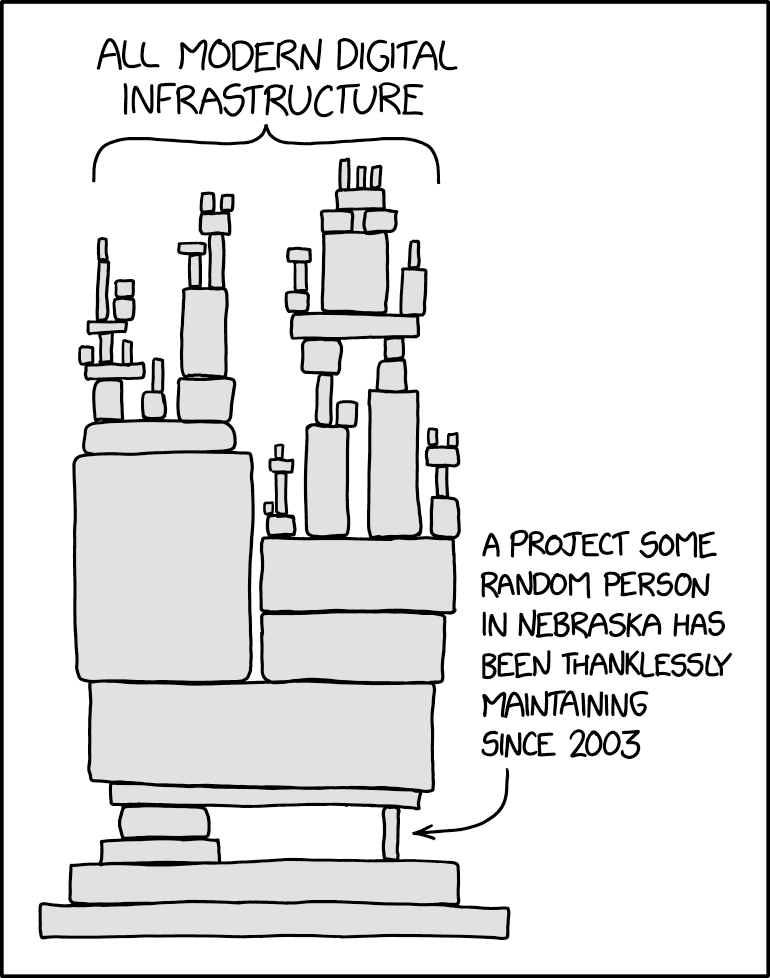
The topic is also not limited to the FOSS world; it’s broadly applicable to all volunteer activities. Can’t feed the homeless in a soup kitchen if you’re sick and sneezing into the soup! Can’t drive to the library to teach adult reading classes if your car’s broken down.
In order to support others, you need support yourself! Who can provide that support? Here are a bunch of cases that work:
- Yourself in the present (with a job — related or unrelated to your FOSS work)
- Yourself in the past (retired)
- Your partner in the present (married to a primary or sole income-earner)
- Your partner in the past (partner left you lots of money after death or divorce)
- Your parents in the present (you’re their dependent)
- Your parents in the past (born rich or received a big inheritance later)
- The state (disabled, a student, or on a similar program)
All these cases work. They provide enough money to live, and you still get to work on FOSS!
There are lots of other good options, but here are some of the bad ones that don’t work:
- Other people via donations: you never get enough donations, and if you put the effort into fundraising required to make it work, that becomes your job.
- Yourself in the future: if you’re living off loans, you’re screwing over future you!
- Nobody: if you’re eating up your savings, you’ll eventually run out of money and be destitute. If you’re fortunate enough to live in a place where “The state” is an option, it will be at a diminished standard of living.
We must always answer for ourselves the question of how we’re going to be supported while we continue to contribute to the digital commons. If you don’t do it for a living, it’s a critically important question. Never let anyone guilt-trip you into doing volunteer work you don’t have the time or money for! It’s a sure road to burnout or worse.
Airplane safety briefings tell people to “put on your mask before helping others.” Why? Same reason as what we’re talking about here: you can’t support others if you’re not first supported yourself. If you try, you’ll fail, either immediately, or eventually. You must be properly supported yourself before you can be of use to others.
 Adventures in Linux and KDE
The proposal of a European Sovereign Tech fund points into the right direction.
https://eu-stf.openforumeurope.org/
We will need some funding that the governments have to provide for pure selfish reasons, to preserve their digital sovereignty in a software-service dominated world.
LikeLike
Great topic!
My two cents:
Personalized donations.
Adopt a dev.
There are a lot of people who would rather donate to a concrete person than to a big company or association, so they can know exactly where their money goes. With that said, it may be a good idea to integrate personal donation links into TWIP if possible (preferably all with the same donation provider, so users do not need to sign up to a dozen of them).
In a similar vein, users might appreciate the possibility of supporting a single dev (maybe because he or she is working on a feature users, companies or authorities have been awaiting for decades.
So, my bottom line would be: Make donations more personal (which would have the benefitial side effect of knowing where priorities are due to people putting their money where their mouth is.
Keep on rockin’
LikeLike
Post scriptum:
Aleix and Harald use Liberapay for their Twitch. So maybe that would be a good starting point.
As for the unified donation provider, a link to a personal “landing page” instead of the commit would do the trick as well I guess.
LikeLike
As like always say: I give when I can until I no longer could, so I won’t have any regret.
I’ve switched to using exclusively open source projects mostly because every time I found a bug, which could be very irritating on a expensive commercial software, I just tell me that if I’m urgently need it to be fixed, I’ve got to fix it on my own. Even if I never do it, this keeps remind me that things are not fixed magically (and AI doesn’t really improve the situation) and that someone has to do the dirty work.
That said, I’ve never paid anyone to work on a open-source project, not out of greed (or because open source users are supposedly broken), but because I don’t know how to estimate financially how much I need to pay someone to work on his free time (and I know “anything positive” is not the right answer). Honestly, I someone would tell me he can fix my bug or implement a functionality for a reasonable fixed amount of money (not 50$/€ an hour because I would expect to much guarantees for this amount), I would gladly help, but clearly wouldn’t feel ashamed if it’s not enough to get a decent salary, because it’s only some kind of help for a specific work.
But I guess many contributors are long time contributors that dedicate a small amount of time (few hours a week, having a job and other occupations) but are incredibly consistent, and they’re adding much more valuable experience to the project that someone overworking for weeks then burning out, even for the same total amount of work. Theses are the backbone of every project since they make it still alive for decades.
LikeLiked by 1 person
I don’t get the willingness of other FOSS developers to side with a driver trying to weasel out of killing a pedestrian and injuring another one by publishing to gullible Westerners an unbelievable story blaming the pedestrians, after he moved to the country invading mine specifically because his one is cheaper due to not valuing human life. In post-Soviet countries, drivers are a privileged class and most infrastructure is built around their convenience, treating pedestrians and public transit users such as myself like human garbage. I don’t believe a single word he wrote about his criminal case, presenting himself like a victim to y’all.
LikeLike