
It’s been a few years since I did an end-of-year “highlights in KDE” post, but hopefully better late than never! 2025 was a big year for KDE — bigger than me or any of us individually.
My focus these days tends to be on Plasma, so that’s mostly what I’ll be mentioning on the technical side. And as such, everything here is just what I personally noticed, got involved with, or got excited about. Much more was always happening! Additional KDE news is available at https://planet.kde.org.
The Wayland transition nears completion
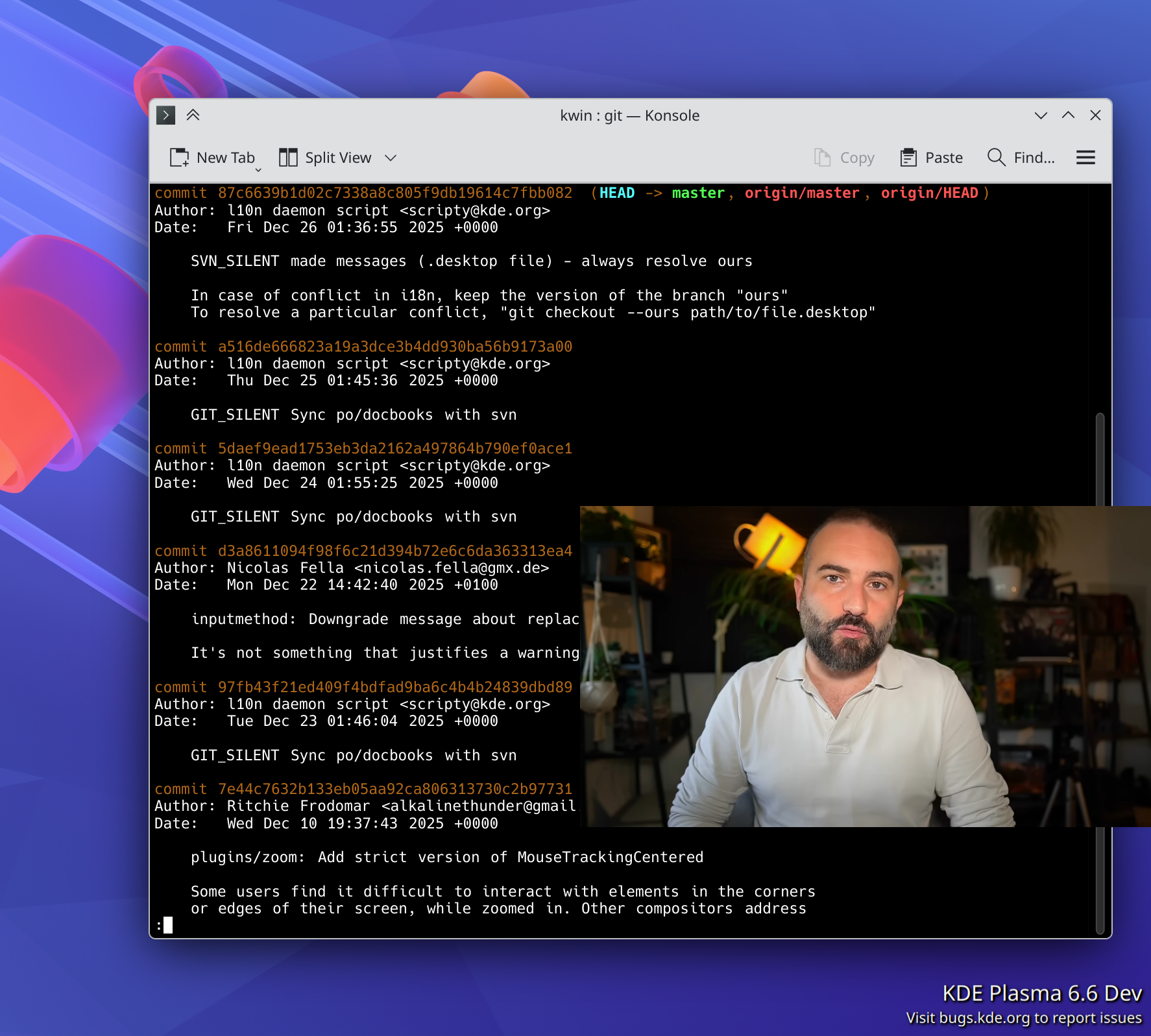
For several years, Plasma has been transitioning to the newer Wayland display server protocol, and away from the older X11 one. 2025 is when it got real: we announced a formal end to Plasma’s X11 session in early 2027.
To make this transition as seamless as possible for as many people as possible, the people involved with the Plasma shell and especially KWin did a herculean amount of work on improving Wayland support on topics as varied as the following:
- Accessibility
- Drawing tablets
- HDR
- Color management
- P010 video color
- Overlay planes
- XRandr emulation
- Screen mirroring
- Custom screen modes
- Implemented support for a large number of protocols, including
xdg-toplevel-tag,xdg_toplevel_icon,ext_idle_notifier,color_representation,fifo,xx_pip,pointer_warp, andsingle_pixel_buffer - Pre-authorization for portal-based permissions
- Clipboard and USB portals
Thanks to this and earlier work, most FOSS operating systems (also known as “distributions” or “distros”) that ship Plasma are defaulting to the its Wayland session these days — including big ones like Arch Linux, Debian, and Fedora KDE. Kubuntu is planning to for the next LTS as well. As a result, our (opt-in) telemetry numbers show that 79% of Plasma 6 users are already on Wayland. I expect this number to increase once SteamOS and the next Kubuntu LTS version default to Wayland. So you see, it really is driven by distros!
Now, Plasma’s Wayland support isn’t perfect yet (any more than its X11 support was perfect). In particular, the two remaining major sources of complaints are window position restoring and headless RDP. We’re aware and working on solutions! I can’t make any promises about outcomes, but I can promise effort on these topics.
This admittedly somewhat messy and plodding transition has taken years, and consumed a lot of resources in the process. I’m looking forward to having it in the rearview mirror, and 2026 promises to be the year that enables this to happen! Expect a lot of Wayland work in 2026 to make us ready for the end of the Plasma X11 session in 2027.
Plasma continues to mature and improve
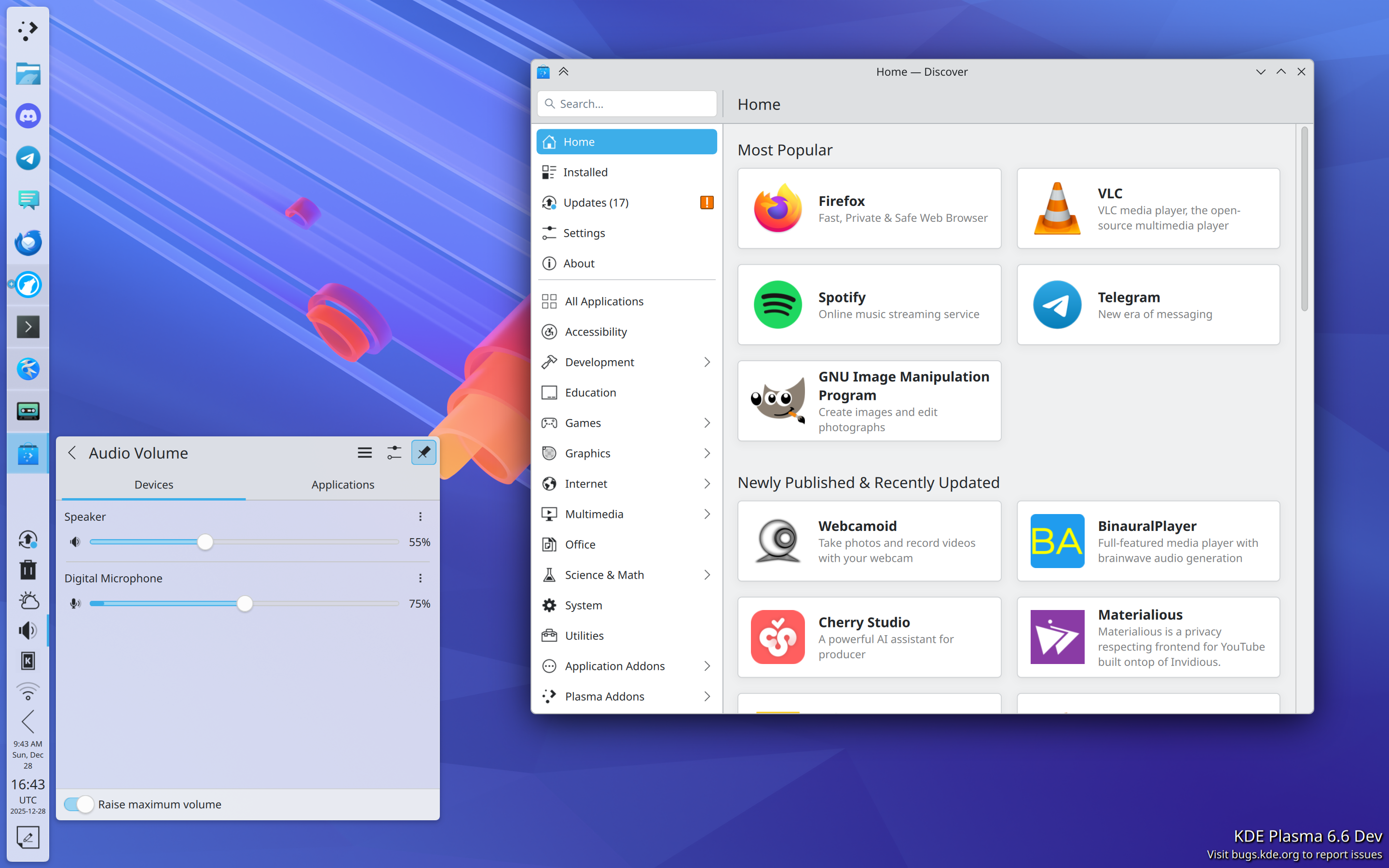
In addition to what I mentioned in the Wayland section, Plasma gained a whole ton of user-facing features and improvements! Among them are:
- Rounded bottom window corners
- Day/night global theme and wallpaper switching
- Saved clipboard items
- Speed graph in file transfer notifications
- Panel cloning
- Per-virtual-desktop custom tiling layouts
- “You missed X notifications while in Do Not Disturb mode” feature, and auto DND mode enabling while in a fullscreen app or video
- Install hardware drivers in Discover (on supported distros)
- New app highlighting in Kickoff
- UI overhaul for KMenuEdit and Info Center’s energy page
- Playback rate selector in the Media Player widget
- Three-finger pinch to zoom
- UX and video quality and file size improvements in Spectacle
- GPU usage monitoring in System Monitor
- Use existing user accounts for RDP/remote desktop
- Printer ink level monitoring
- Inline print queue viewing in the Printers widget
- Only show the screen locker and logout screen UI on one screen, not all of them
- OCR in Spectacle (coming in Plasma 6.6)
- Monochrome colorblindness filter (coming in Plasma 6.6)
- Option for automatic screen brightness on supported hardware (coming in Plasma 6.6)
- Option for virtual desktops to only be on the primary screen (coming in Plasma 6.6)
Phew, that’s a lot! And Plasma is getting rave reviews, too. Here are a few:
- https://www.xda-developers.com/after-decades-of-windows-linux-kde-spoiling-me-rotten/
- https://www.pcworld.com/article/2803571/dont-toss-your-windows-10-pc-try-switching-to-kde-plasma-instead.html
- https://www.theregister.com/2025/06/18/kde_plasma_64_released/
- https://txtechnician.com/blog/adventures-in-linux-3/kde-plasma-the-ultimate-configurable-linux-desktop-19
- https://www.youtube.com/watch?v=2hf7TtqHVA0
A decade ago or so, it used to be that Plasma wasn’t seen much as the default option for distros, but that’s changing.
Today Plasma is the default desktop environment in a bunch of the hottest new gaming-focused distros, including Bazzite, CachyOS, Garuda, Nobara, and of course SteamOS on Valve’s gaming devices. Fedora’s Plasma edition was also promoted to co-equal status with the GNOME edition, and Asahi Linux — the single practical option for Linux on newer Macs — only supports KDE Plasma. Parrot Linux recently switched to Plasma by default, too. And Plasma remains the default on old standbys like EndeavourOS, Manjaro, NixOS, OpenMandriva, Slackware and TuxedoOS — which ships on all devices sold by Tuxedo Computers! And looking at the DIY distro space, Plasma is by far Arch users’ preferred desktop environment:
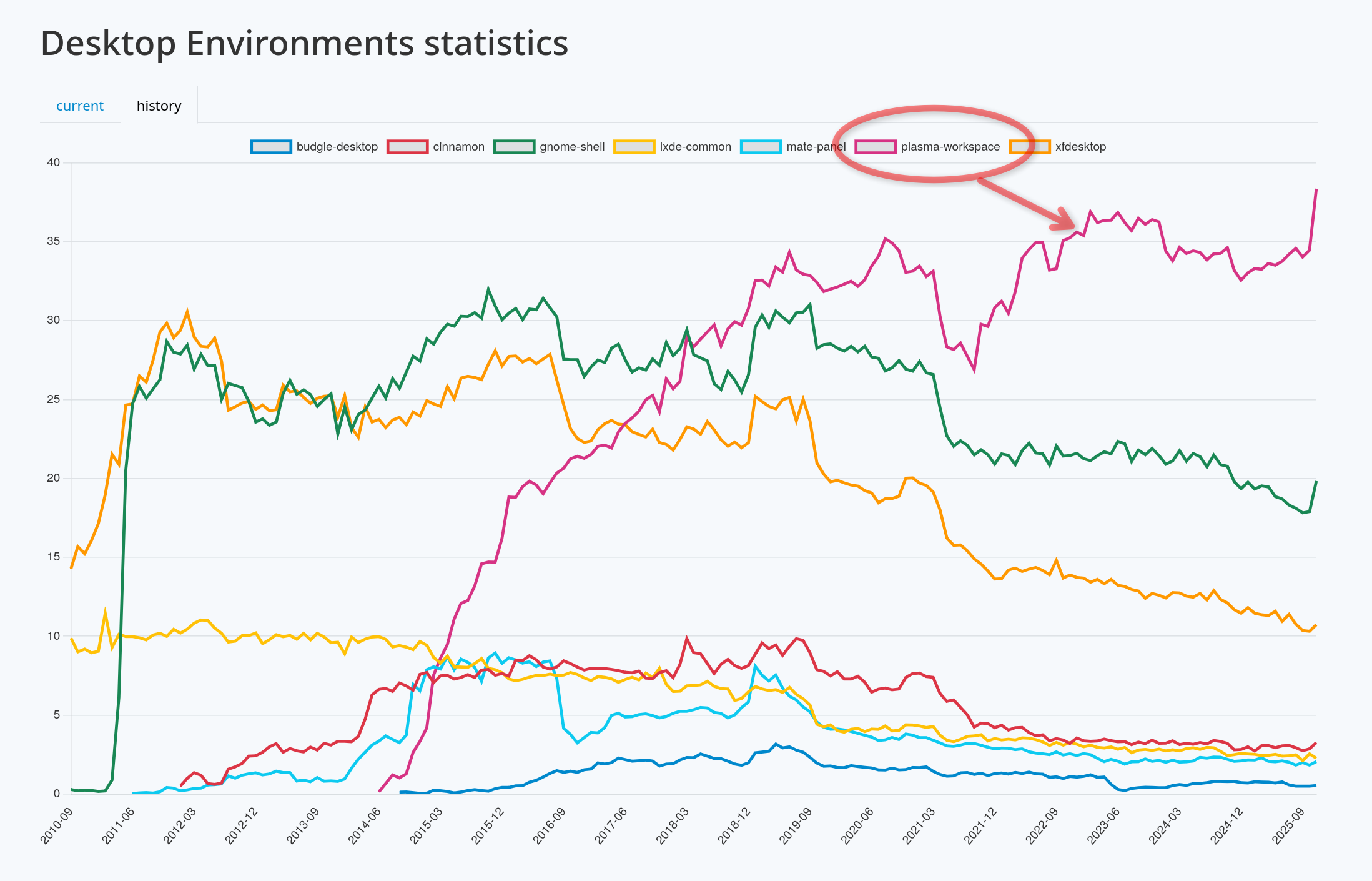
It’s a quiet revolution in how Linux users interact with their computers, and my sense is that it’s gone largely unnoticed. But it happened, so let’s feel good about it!
In fact, if we exclude the distros that showcase their developers’ custom DEs (e.g. COSMIC, ElementaryOS, and Linux Mint), at this point the only significant distros missing here are the enterprise-oriented ones: Debian, RHEL, SLE, Ubuntu, and the like. It’s something for us to work on in 2026, but clearly the current state is already great for a lot of people, including gamers, artists, developers, and general users.
KDE Linux grows
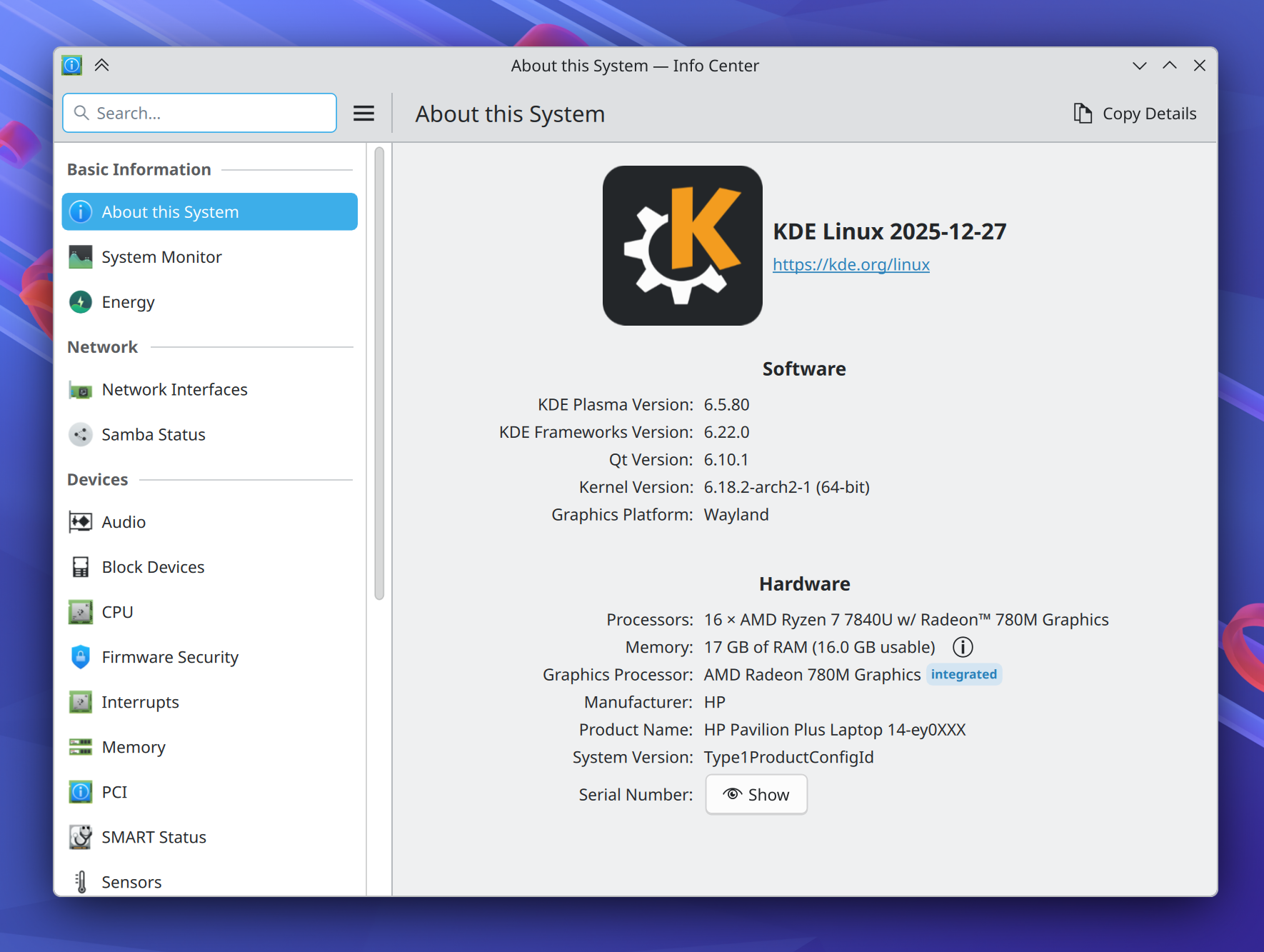
On the subject of operating systems, at Akademy 2024, Harald Sitter revealed the KDE Linux operating system project to the world. But in 2025, it spread its wings and began to soar.
Despite technically still being an Alpha release, I’m using this in-house KDE OS in production on multiple computers (including my daily driver laptop), and a growing number of KDE developers and users are as well. Thanks to its QA and bulletproof rollback functionality, you can update fearlessly and it doesn’t feel like an alpha-quality product. You don’t have to take my word for it; ask Hackaday and DistroWatch!
This project has been very special to me because I believe that KDE needs to take the reins of OS distribution in order to offer a cohesive product. The earlier KDE neon project already broke the ground necessary to make this kind of thing socially possible; now KDE Linux is poised to continue that legacy with a more stable and modern foundation.
To be very clear, none of this is an attempt to kill off other distros. Far from it! In fact, an explicit goal is to showcase what a well-integrated KDE-based OS looks like, so others can take notes and improve their offerings. And there’s still lots and lots of room for specialized distros with different foci, and DIY distros that let people build their own preferred experiences.
I’m really excited to see where this project goes in 2026. You can learn more on the project’s documentation wiki: https://community.kde.org/KDE_Linux
Fundraising performance is completely bonkers
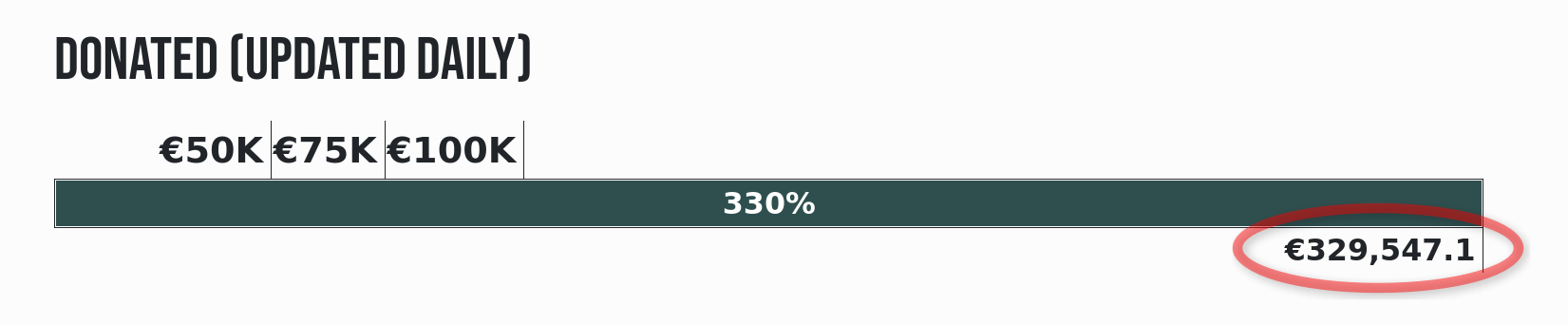
This is the second year that Plasma users have seen a donation request pop-up in December. And it marks the second year where this not only didn’t kill KDE, but resulted in an outpouring of positivity and a massive number of donations! Last year I wondered if it was repeatable. It’s repeatable.
That plus an even more ambitious and well-organized end-of-year fundraiser propelled KDE to its best ever Q4 fundraising sum: nearly €330,000 as of the time of writing! KDE e.V. (the non-profit organization behind KDE) is going to end up with a 2025 income that’s a significant fraction of a million Euros, and mostly crowdsourced, too.
I say this a lot, but sums like this truly help keep KDE independent over the long haul. But how, specifically?
First, by being mostly funded by small donors, KDE retains its independence from any powerful and opinionated companies or individuals that happen to be patrons or donors.
Second, with such a large income in absolute terms, KDE e.V. now has resources to rival the private companies in KDE’s orbit that contribute commercially-funded development to KDE (like mine), and that’s a good thing! It means a healthy diversity of funding sources and career opportunities for KDE developers. It’s systemic resilience.
And finally, with money like this, KDE e.V. is able to fund projects of strategic interest to KDE itself, and fund them well. Historically KDE’s software has been developed by volunteers working on what’s fun, companies funding what supports their income, and some public institutions funding their specific use cases. And that’s great! But it leaves out anything that’s not fun, doesn’t make money, and isn’t directly relevant for governments. These are the kinds of large projects or maintenance efforts that KDE e.V. is now able to fund if necessary.
It’s a big deal, folks! This kind of fundraising performance puts KDE on the map, permanently. And it’s mostly thanks to people like you, dear readers! The average donation is something like €26. KDE is truly powered by the people.
If you can make a donation please do so, because it matters, and goes far!
KDE’s overall trajectory
It’s positive. Really positive.
But when I joined KDE in 2017, the community was a bit dejected. After giving my very first public conference talk at Akademy 2018, multiple people came up to me and said some variant of “thank you for this optimistic vision; I didn’t think I could feel positive about KDE again.”
These reactions were really surprising to me; without the benefit of history, I had no idea what the mood was or how things had been in the recent past. But some statistics about contributor and commit numbers bear out the idea that 2013-2017 was a bit of a low period in KDE’s history, for various reasons.
But since then, KDE has come roaring back, and you see it in positive trends like adoption by hardware vendors and distros, great fundraising performance, good reviews, positive user feedback, and new contributors.
Everything isn’t perfect, of course; there are challenges ahead. Bugs to fix and stability problems to overcome. The Wayland transition and a new theming system to complete. Features to add that unlock Plasma for more users. More effort to put into getting Plasma-powered operating systems and devices into the mainstream.
But the KDE community is up for it. KDE is a mature institution that’s resisting enshittification, and making the world a better place in ways both big and small. My work on KDE represents by far the most meaningful part of my career, and I hope everyone else involved can feel the same way. What we do matters, so let’s go out there and do it even better in 2026!
 Adventures in Linux and KDE
well done another great year, keep up the excellent work you and the team do!
LikeLiked by 1 person
Over 20% of communicative users seems like it would be a big number to abandon, and hopefully it doesn’t come to that, but people out there are starting to fill the gaps on specific slightly more niche needs, e.g. https://github.com/luisbocanegra/kwin-minimize2tray so am giving it a go. PS – the comment form doesn’t seem to be allowing spaces for some reason, the browser (Chrome) is treating it as PgDn? Had to type this elsewhere and paste it.
LikeLike
The idea is definitely not to abandon 20% of the userbase! Rather, the idea is to meet enough of their needs (or their distros’ perceptions of their needs) that their distros go Wayland-by-default and they follow suit.
LikeLike
thank you for the work that all of you do on kde – I run it on every machine I use (that runs a DE) and love it. it’s to the point where having to use windows or Mac feels like a real downgrade compared to the plasma experience.
LikeLiked by 1 person
https://qa.debian.org/popcon.php?package=tasksel
19.84% of Debian users use GNOME, while 9.58% use KDE. This is a great achievement considering that Debian defaults to task-gnome-desktop when you select task-desktop in the installer.
https://qa.debian.org/popcon-graph.php?packages=task-gnome-desktop%2Ctask-kde-desktop&show_installed=on&want_percent=on&want_legend=on&want_ticks=on&from_date=2012-01-01&to_date=&hlght_date=&date_fmt=%25Y-%25m&beenhere=1
And the user base of KDE is still growing!
LikeLiked by 1 person
https://qa.debian.org/popcon-graph.php?packages=task-gnome-desktop%2Ctask-kde-desktop%2Ctask-xfce-desktop%2Ctask-cinnamon-desktop%2Ctask-mate-desktop%2Ctask-lxde-desktop%2Ctask-lxqt-desktop%2Ctask-gnome-flashback-desktop%2Ctask-lomiri-desktop%2Ctask-phosh-desktop&show_installed=on&want_percent=on&want_legend=on&want_ticks=on&from_date=2012-01-01&to_date=&hlght_date=&date_fmt=%25Y-%25m&beenhere=1
And here’s a graph covering more DEs.
LikeLike
Thanks for all the weekly KDE blogs. It is a nice way to stay informed about KDE.
LikeLiked by 1 person
Don’t drop X! Certain applications expose bugs when running under WL, I had for instance problems to drag-drop e-mails to IMAP folders in Kontact, this was instantly solved by falling back to an X session.
This is the great thing about KDE and Plasma, if you don’t have GL/EGL it works with Xrender. If you can’t use WL you can use X.
But don’t forget, it’s a stack all the way from video card to desktop applications. No matter how good Plasma WL is, certain apps will just work better on the X stack for a long while. Even when the X version is no longer on par with WL, why deny users the possibility to fall-back.
LikeLike
I guess it will allow focusing on improving the Wayland session.
But don’t worry, users aren’t denied to fall-back to X11. You can stay at version 6.7. Distros will support Plasma X11 for a very long time. Debian until 2030, Ubuntu until 2031, RHEL until 2035. So up to 10 more years of Plasma X11. So just dropping X11 support in 2027 doesn’t mean people can’t use a X11 session anymore.
LikeLike
The arch Linux analytics are such a bad metric because they are opt in. Obviously those tilling window managers are not that high no matter how trendy they are. The only reliable ones I’ve found are the fedora countme ones since they are opt out https://raw.githubusercontent.com/ublue-os/countme/refs/heads/main/growth_upstream.svg
Asahi Linux doesn’t support KDE only either, when I went to a local installfest they asked me which DE I wanted it between KDE and GNOME as that’s what was available.
As for Debian, could you elaborate on your plans? Because your coworkers seem to not recommend it at all https://www.reddit.com/r/debian/comments/1pn582t/kde_dev_do_not_recommend_plasma_on_debian/
LikeLike
The Fedora stats are not without problem either. The Gnome desktop has traditionally been bundled with Fedora Linux to the extent you could say it is the default desktop environment on Fedora. Fedora Linux promoted the KDE Plasma Desktop variant to full “Edition” status as late as April 2025, before that it was only an obscure “spin”. Looking at the current “Get Fedora” page, I see “Workstation” at the start of the list (“the Linux desktop you have been waiting for”), and “KDE Plasma” only second.
On Arch Linux the different desktop environments are truly on an equal footing.
LikeLike
Small correction: Kubuntu already switched to the Wayland session by default since 24.10 (first release with Plasma 6).
LikeLike
Right, I was thinking about the LTS release, not the other ones. Clarified in the post.
LikeLike
And when you’re 90% done, Qt7 will be released and the whole KDE rewrite/regression show starts over again.
LikeLike
Qt6 was a smooth and quick transition. I don’t think this is such a big issue anymore.
LikeLiked by 1 person
I’m so happy about the state of KDE and its community, so much has been accomplished in the decade and a half since I started using it.
Wayland support was improved so much, Plasma is snappier and more stable than ever, and the community seems nice and dynamic.
It’s the software project that brings me both the most joy and productivity in my day-to-day life, and I’ve always had a good experience with reporting bugs.
LikeLiked by 1 person
I’m a very happy KDE user. I’m still on X, because auto-type functionality in KeepAssXC didn’t work the last time I tried Wayland session.
This makes me curious, because I never saw anyone mentioning this solved/unsolved problem in KDE. So I’ll ask now: 1. do you guys use a password manager? 2. if yes, is it a password manager with auto-type functionality? 3. if yes, does it work in your Wayland session? 4. if yes, is it KeepAssXC or something else?
(If you answered “no” to all questions, do you have a great memory, and you don’t need passwords, and you never type passwords in public??? I your secret sauce is something else?)
LikeLike
Here’s the system I use: https://invent.kde.org/kde-linux/kde-linux/-/issues/449#note_1363335
I feel pretty strongly that it’s close to ideal for most people, and that with better integration and UI, it could basically solve the “password problem” permanently.
LikeLike
I tried Fedora KDE 43 and found my Linux distribution. I have been a long time Windows user but Microsoft has gone all AI on everything sticking it in every bit of their products especially Windows. Not against AI but I want to choose where I use AI not Microsoft. My AMD 5600g desktop actually runs much better now on Fedora than it has on Windows 25H2. So far I don’t see any negatives to switching. I can do everything I did on Windows without and issues.
LikeLiked by 1 person
I know that this isn’t (strictly) a KDE issue, but it might be worth looking into how LibreOffice fares on KDE. Currently, the qt backend has pretty poor support for fractional scaling. It also doesn’t have pinch to zoom gestures (LO on gnome does). Both of these make a pretty annoying experience for KDE users on a laptop who want to use the default office suite of most distros.
Bugs:
LO development is extremely slow, these issues probably won’t be fixed for years (if ever). Would be awesome if KDE developers could have a look…
LikeLike
I’ve been using KDE since version 3, and I stuck with it even through the frequent crashes and many bugs. But over the last 15 years, there has been a massive shift for the better. From my perspective, this is especially true regarding the attention to detail and the overall usability of the environment. I’m pleasantly surprised that this trend isn’t just maintaining its pace—it’s actually accelerating.
I believe the overall positive state of things is also largely due to the excellent communication with users that Nate and others provide every single week. You’re doing a great job promoting yourselves and other developers. Perhaps that’s also why you feel good about the work; you can sense that people know about your great results and truly appreciate them.
I would like to thank everyone involved in KDE. Thanks to KDE, I enjoy using my computer because it makes my life easier and better—which is a welcome change from everything else going on in the world today.
PS: I used to make one-off donations a few times a year, but while writing this comment, I set up a recurring monthly contribution.
LikeLiked by 1 person
Thanks for the kind words and the new recurring donation! That really helps KDE.
And indeed, the Plasma team has put a ton of effort into reliability and stability work recently. We’re still not at the point I think we need to be at, but we’re at least pointed in the right direction, and making active progress to get there.
LikeLike
Quick idea for 2026: Tone down the icons on the left for a less busy look.
https://images2.imgbox.com/40/8f/dasCeVJP_o.gif
LikeLike
What happened to Plasma Bigscreen? I’m still looking for a decent solution for a Linux TV Set top box experience, with tv remote support.
LikeLike